Peter Foley
San Francisco artist Peter Foley in work that ranges from painting to collage to ceramics, strives to make art that looks as if it is and has always been just there. Like a stunning rock formation, a meadow’s dazzling, lush wildflowers, or the sensuous, undulating bark on a Manzanita tree. Someone might be clever enough to capture those gifts of nature in a photograph or painting but they, for various amounts of time, have been just there.
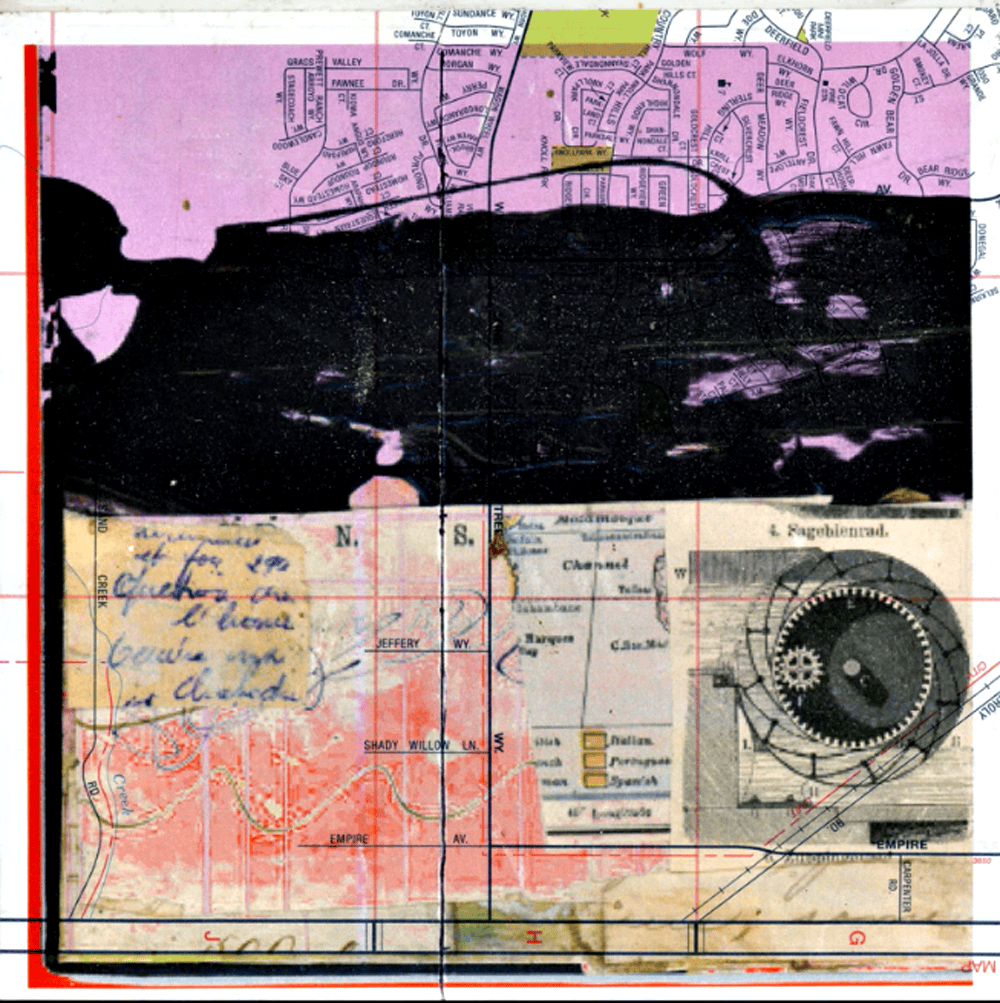
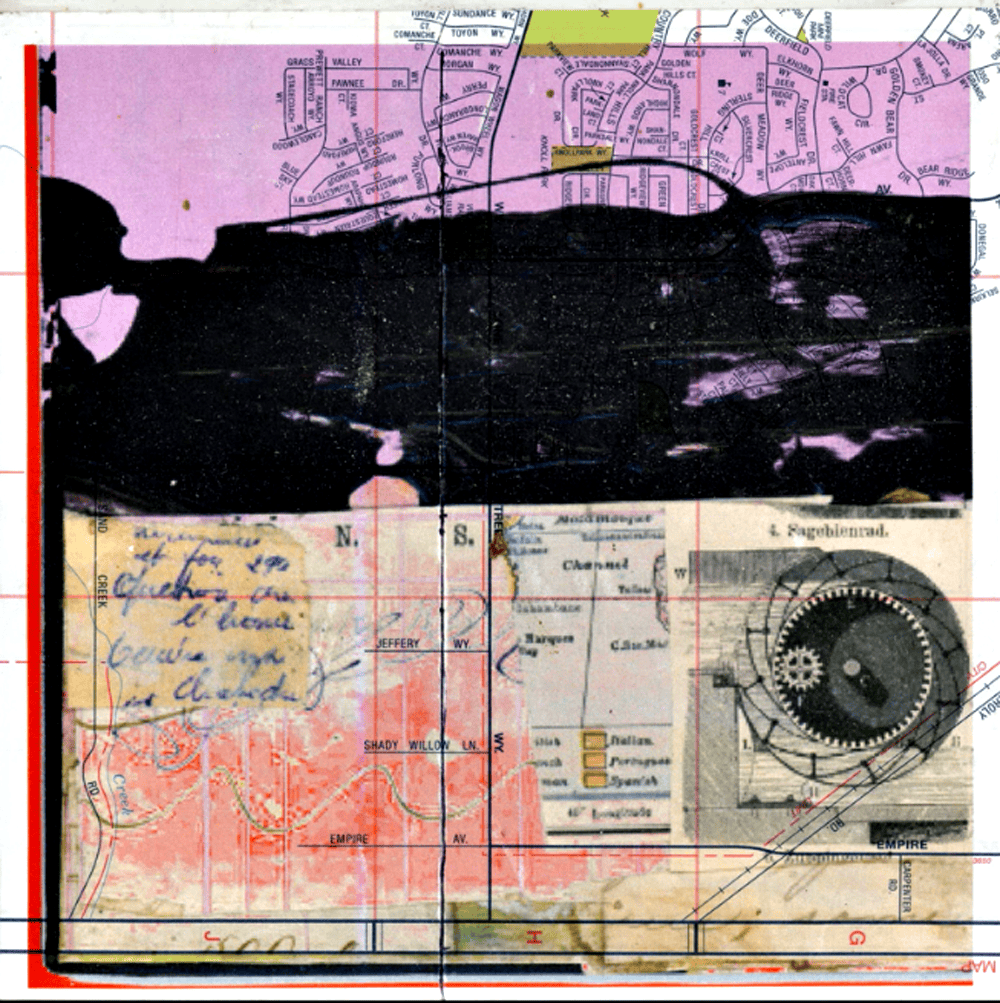
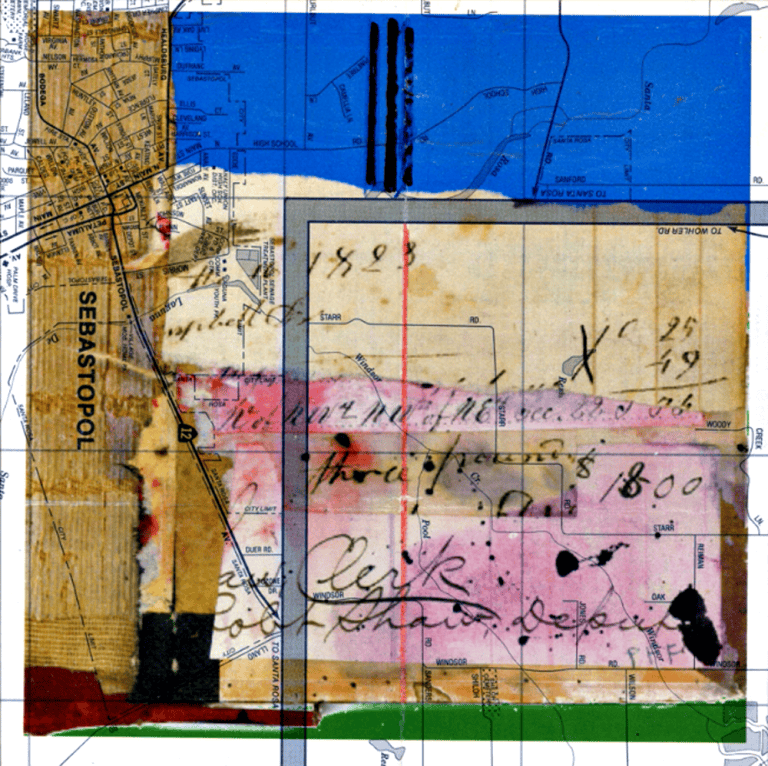
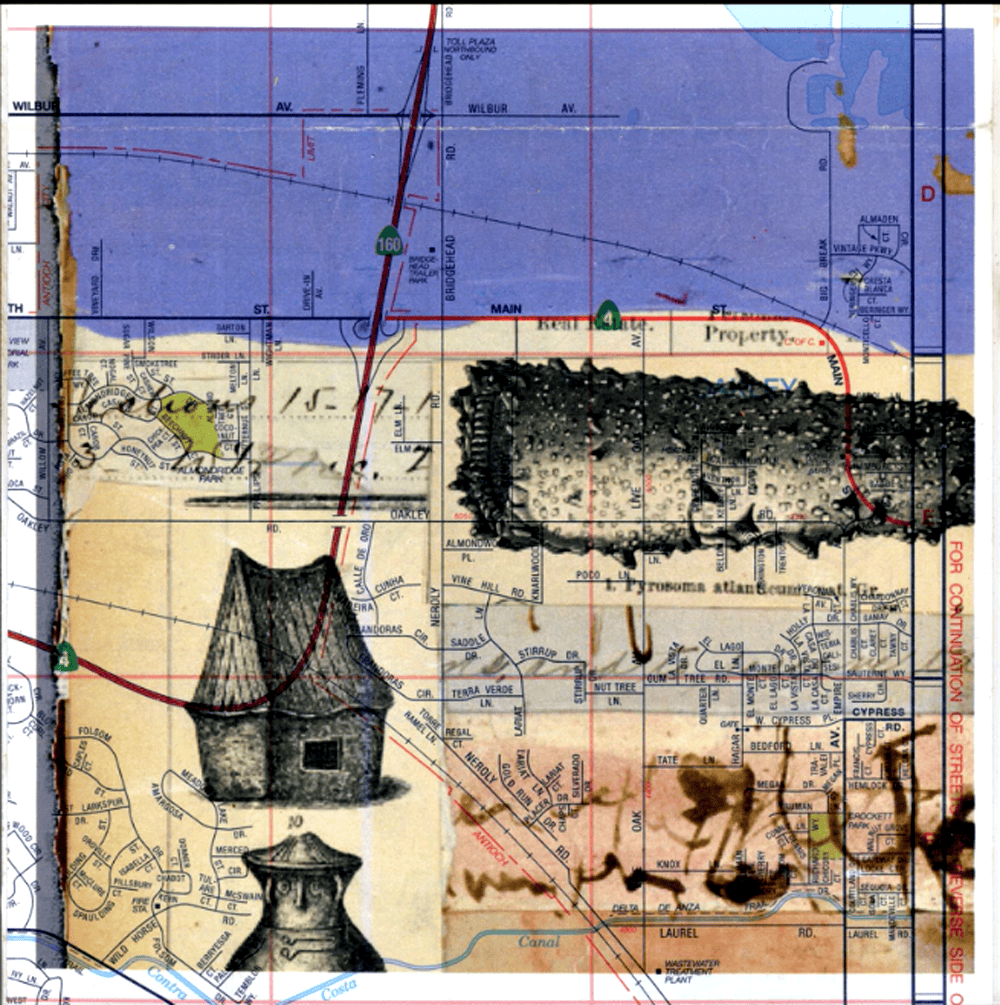
Even so, Foley’s maker’s hands are everywhere evident in his body of work. There is art marking rendered with abandon and high kinetic energy a viewer is allowed to decide if the marks express anger, exuberance, disruption, destruction, embellishment, or all of the above and more. Especially in the collage work, there are choices of things seen—archival documents, historical texts, photographs of classic sculptures, handwritten and typewritten notes, black-and-white drawings from scientific journals. Often, the paper materials are partial scraps with torn, weathered edges and surfaces that have been subject to the unavoidable entropy of time passing, such as smudges, discoloration, wrinkles and tears. The paint is equally spontaneous, arriving in solid, thick layers or more sparingly rendered in seemingly random swirls and shards of vibrant or ominous or bleak or soothing colors.
Foley has exhibited his work at the San Francisco Museum of Modern Art, the Oakland Museum, Santa Barbara Museum of Art, Montalvo Center for the Arts, Triton Museum, Richmond Art Center, University of California, Santa Cruz, Stanford Art Spaces, Stanford University, University of Hawaii, Hilo Hawaii, Museo de Arte y Diseno Contemporaneo, San Jose Costa Rica, 22nd Triennale Grenchen, Switzerland, the Mary Porter Sesnon Gallery, and the Climate/Gallery among others. He is a recipient of the James D. Phelan Award for Visual Art from The San Francisco Foundation.
In a conversation in June 2025, Foley responded to invitations to speak broadly about his background, early influences, and the process and practices he employs when making art. In the Q&A’s second section, he reflects on specific series and works in his wide ranging portfolio.
For people who may be familiar with your work, but not your personal and professional history, please tell us about the path you followed to becoming a maker of art.
I grew up in San Francisco. I lived on the Great Highway, which is right on Ocean Beach. So I spent a lot of time on the beach when I was young. I went to Lincoln High School, a public high school, then City College.
I got interested in ceramics in high school. That kind of put me into the art realm. I thought I wanted to be an artist. The teacher in high school was a friend of Roy Walker, the well-known ceramicist (I studied with) at City College. At that time, I was collaborating with artist friends, one of whom went to CCAC (California College of the Arts) in Oakland. He said this is where it’s at, you have to go to CCAC. So I did my BFA at CCAC. Then a masters at SF State University.
What about ceramics interested you?
Ceramics were hands-on and an immediate process. You didn’t need any super skills at that point. You didn’t have to be a painter or fine draftsman. You could make what you wanted with your hands making what your brain was thinking. I liked the whole mud thing, the tactile feel of clay, putting stuff together. It just appealed to me.
I didn’t pursue it because it required a kiln and studio space. At that time, once you got out of school (access to those was not readily available). Now, there are a lot of ceramic studios you can use. So I got into print making—that’s what my degree is in. I like processes. After I graduated, I did other things. Primarily now, I’m painting and getting back into ceramics through adult education class where you do your own thing. I don’t need any teaching anymore, I just want to make stuff.
Do you believe living and spending time on the beach influenced your art making?
On the beach, I surfed, but it was mostly just hanging out. I remember always being interested in art. I remember even when I was young going to museum at 7 or 8, with my father. I was impressed by the classical work, the old masters’ paintings. It intrigued me. In the fifth grade I did a drawing they actually used in some music book as an illustration. I was always doing something art-wise. It was the Legion of Honor Museum in San Francisco. It’s kind of an iconoclastic museum stuck on a hill, but that was the thing.
Talk to me about the influence of your teen and young adult experiences on the directions you’ve chosen, the spaces you explore in the art world.
It was an internal thing. I’d always been fascinated with art. It intrigued me and was just inside of me to pursue it. I was fascinated with the process of how people made things. I didn’t make living doing art. I had to do other things to survive because I had a kid and a family and so on. I worked in trades: pipe-fitting as industrial plumber.
I have two kids and a wife—we’ve been together forever. She’s a psychologist so she takes care of my mental needs. (Laughing) Are my kids in the arts? No, Of course not. I think it skips a generation. They say, I want a real job.
Is there something most true of you art that is constant and perhaps indicates what’s next as much as what has been created?
All my art has been a continuum. As I do the art and see new things, then that evolves into the next direction. My work is all over the place. When I lock in to a thing, I do a series and pursue it until it either it bores me or I can’t pull anything more out of it.
Each of those series have been historically attached to each other. If you go back to my early work you see elements of what I do now. Either the composition or how I throw stuff down, marks, whatever. There will be elements of that in everything.
What concerns me as I’m working, is I try to make things that don’t seem contrived. Which is one of the hardest things to do. Especially in abstract art, when you’re not dealing with something substantial but with something that’s always moving. It’s easy to get into a cliché thing. You have to keep the freedom going to capture whatever you’re thinking about in the moment. I try to reproduce using things I see. By mixing it up, it appears to be in a natural state. Like when you see a graffiti wall with six guys painting over it, you get elements of each piece coming through. I’m not reproducing graffiti art, but I’m using that formula of layering and depth so it gets a history and a story.
Let’s explore some of the series you create and several specific works, beginning with the “Untitled Bandera, 2023,” that is included in the Rising Tide exhibit at HATF’s Floating Gallery in Alameda.
It’s one of a series I’m still working on of works on un-stretched canvas, grommeted to hang. The art becomes not only a painting, but an object. It’s a two-dimensional sculpture. When canvas is not stretched, it has elements of hardness and softness. It’s a sculptural body. The paint is layered on thick so it has a textural feel as well. If you look at how it’s composed, you can see elements of the History Lessons (a series discussed later in the interview) in terms of how the marks are laid out and what things conflict with each other. It’s like a continuing study of a work’s physical properties. To the unsuspecting viewer, there’s more there than what meets the eye.
What would you say if I told you my eye drifts to the edges and multiple centers in the work. My mind shapes the idea of abstract flags; my subconscious ponders the spacial dynamics of things close, far, next to, layered, overlapping, interrupting. Memory brings up the visual thunder of the painting’s vibrant red, olive green, and those black “teeth” that bite at the edges and seem essential?
That’s exactly correct and what I was thinking about. The bottom line is making a composition that’s interesting and pulls the viewer in. Then there’s a mysterious dialogue going on that makes it more intriguing. Those shards of black are important and without them it wouldn’t have the same impact. It was just happening and I saw it and pursued it. In person, you realize it’s many layered. The black was like an earlier work that reappeared through other layers. I kept them and knew they were right. I applied more and in the end, they were a nice contrast.
Please talk about the making of works in the Altered Sheets collection and about the Anemic Objects. There are parallels but perhaps, also essential differences?
They’re a variation on a theme done at two different times. The concept was my interest in the decay and history of everything. I’m using large areas of color as a contrast to the written image or the paper. Getting funky. It keeps it interesting and confusing. I don’t want to explain it too much, because then, it loses the mystery. If it’s all worked out for me, that’s not my stuff. Like a picture of a rose in a vase on a table, depending on how it’s made, it doesn’t interest me. I like more intellectually abstract art. (If there’s something unusual about the materials used to create water, petals, or the table, that would instantly be more interesting to him, Foley suggests.)
“Studio 15 Views,” is a book-like work dated 2024. Did you write the text? What is the story of the work; what can you say about it’s origin, evolution, discoveries made, the things intentionally left unresolved?
I wrote the dialogue. I have paintings laying around at my studio, all over the place. The images are fragments of larger paintings. I like the randomness. What you see is a piece of a larger thing, but the piece being shown was not a specific drawing made for this. I’m taking and using a random view of something that catches my eye. The dialogue is thoughts of the moment. It’s me pretending to be a poet. Then again randomly, I didn’t put the paintings with a particular dialogue. I just threw it down and what is was is what it was. It’s Zen composition of putting a book together. Yes, I do sometimes change it later, but I hate to say that. I try to keep it as it is.
And the zines, especially one titled “tarantula no. 6 (poetry issue #2).” Tell me the creation story and process of selecting the poems and images. And speak also to the order you’ve chosen that might or might not have correlation in mind.
It has the mannequin head on the cover? There’s a place in the city called SCRAP. I was down there one day and they had all these mannequins. I said, oh man, these things are really interesting. I wandered around and photographed them inside and outside. They were spread out all over. The poetry was from people a friend recommended. I didn’t tell the poets what to write. There was some great stuff. Then I just threw it down. To me, as soon as you overwork something, it’s dead. There’s a freshness about randomness that you don’t get any other way.
Tell us the history of History Lessons. It’s marvelous that each time a person returns to look at them, it’s possible to see new things.
I don’t know what provoked me to put that series together, but I wanted to work in a large scale, collage manner. I was interested in the concept of art culture. It was about so-called primitive art versus Western European art. I mixed them up in the images so it’s a story. Then by layering it again, it gave it a historical presence of time over time. The distressed things and the blotting out of things was as if I was trying to erase certain images. The essence was a culture clash between the iconography of tribal things versus classical, European images.
There were post-colonial issues of Western Europe trying to take over the folk art of various cultures. It was as if the Western art was superior to the indigenous art. I love tribal art: the iconography and markings. I was just making up things, making my own version and mixing it up. I kept exploring and each piece led to the next. Things I learned in a previous piece I applied to the next one. The actual mark making, how to apply different layers: certain things would pop out and I’d explore that in the next piece. It was more about the making of a piece, not the intellectual. It was process, construction.
Which brings us to working on different surfaces. Please share thoughts on the experiences you’ve had with cardboard versus canvas, for example, or when addressing an image or idea a second time, or your overall approach to selecting different materials, and so on.
It’s whatever’s at hand that feels like it will work at the moment. Working on canvas in History Lessons, I didn’t feel like gluing things on to canvas. They are large, 4 x 5 feet, and made on super hardcore insulation panel, so it’s really stiff. You can brutalize the surface with a sander and staple to it. Whereas canvas, it’s too delicate for abuse. Except for little collage elements as highlights I’ve used, my works on canvas are typically paint.
With History Lessons, what you don’t see is they’re actually in a box that’s a frame. It. Has plexiglass over it with exposed screws. That gives it an archival museum quality, an academic aesthetic. The fragments and weird stuff become more important because of the frame. Some people don’t have the same response to something put together, something collaged: “Oh my kid could do that.” But in this box, it makes the pieces more academic and (places them) in a thoughtful realm.
One last question: What art are you drawn to view?
At this point, I’m selective about what I’ll get up and go see. It’s mostly lyrical abstraction. stuff that has elements of something (so it’s not totally abstract), but thought-provoking. Like people say, good art is good art. I like classical art and all kinds of things, but what I really like most is more abstract art.