Mildred Howard
Oakland-based artist, activist, educator, and chef Mildred Howard was born in San Francisco and raised in South Berkeley. Her parents owned an antiques business and were politically active in the community. Howard was included in their conversations about civic participation in labor unions, protest marches to protect civil rights, resisting segregation and redlining through advocacy and grassroots actions. Lifting up the voices of Black people and other underrepresented groups was a focal centerpiece of family life.
At other times, tinkering with supplies from the family business engaged Howard’s vibrant curiosity—a dominant, life-long trait—and dance, fine art, photography, and filmmaking were constant companions throughout her formative years. This rough, early sketch of Howard as an enthusiastic learner has remained the outline for decades; leading Howard to build an extensive, multimedia body of work, accumulate numerous credentials, and receive countless accolades.
Howard holds an Associates of Arts Degree & Certificate in Fashion Art from the College of Alameda, Alameda, CA; an M.F.A. from Fiberworks Center for the Textile Arts at John F. Kennedy University in Berkeley, CA; and honorary Ph.D. degrees from the California College of the Arts in San Francisco, CA and California State University, East Bay in Hayward, CA. Her assemblages, installations, and exhibitions have earned broad national and international recognition and numerous honors, most recently, a 2025 Guggenheim Fellowship in Fine Art. In the Bay Area, particular attention has centered on large-scale installations and the breadth of Howard’s work; resulting in art in the permanent collections of the Berkeley Art Museum, Berkeley, CA; the de Young Museum, San Francisco, CA; the Oakland Museum, Oakland, CA; SFMOMA, San Francisco, CA; the San Jose Museum of Art, San Jose, CA, and others. A thirty-year retrospective, “Spirit and Matter,” was exhibited in 2015 at the Richmond Art Center in Richmond, CA.
As an educator, Howard’s influence weaves its way through multiple generations of artists. From courses taught at Stanford University, the San Francisco Art Institute, and the California College of Arts and Crafts to establishing the Institute for Inquiry workshops and other curriculum at San Francisco’s Exploratorium, young artists-to-be, college students, classroom art teachers, and professional artists have gained access to Howard’s art and artistic insights, creative practices, and her extensive knowledge of geography and American and World history.
In conversation with Howard, each topic unfolds into a marvelous no-holding-back panorama of an artist’s rich, interior thought-world and a public life well-lived. In her 2,500-square-foot, street front studio in West Oakland, the upper floor is a live-work space. Below, there is storage: artwork in crates, leaning on walls, tucked under tables, stored in flat files. West-facing windows and skylights illuminate “tons of books” and past projects. The evidence of decades spent creating artwork is obvious, but she expresses little sympathy for reviewers and writers who over-focus on age, gender, or the color of her skin.
Let’s tackle that “package-a-person” dynamic first, shall we? Talk to me about media and review coverage you have received..
Unfortunately, there’s a tendency to present me in a reductive way that might be convenient for the author, but is short-sighted about what’s really significant. Before my work even enters into the discussion, I might be summed up as an “80-year-old African American artist.”
First of all, that’s inaccurate — I’m 79. But more importantly, the art world’s obsession with age is absurd. And I want people to see me for who I am, which obviously includes being Black; it’s fine if that’s discussed in a consideration of my work. But I can’t help but notice an inconsistency in these kinds of profiles. You’re never going to read a piece that starts out by describing someone as “a White American artist.” The art world is fickle and racist.
The world of art was something other than fickle during your childhood, correct? Tell me about art-making, using your imagination, and experiences that were uniquely yours as a child of antique dealer parents.
I was always very curious about the world, and I was surrounded by the arts. As a young child, I could walk over to the South Berkeley Congregational Church, where there were arts and crafts classes offered two doors down from my house. My parents would take me to the de Young, the Japanese Tea Garden, the Oakland Museum of California. At that tie the Oakland Museum was right on Lake Merritt in an old victorian house. Art was everywhere, and I had a natural sense of wonder, which my parents saw and encouraged. It’s the same sense of wonder that continues to guide my work and keeps me in the studio.
And those art experiences at the church…?
Some were more formal classes, and some were just the result of art supplies laying around. I loved that huge box of Crayola crayons with all the colors. I remember enameling on copper when I was really young. We made pins, like a brooch or ear rings. We sprinkled little pieces of glass on the copper and the instructor put it in a tiny kiln. I thought it was magic. Later, I remember coloring maps in elementary school with unusual colors. It sparked an interest in places I’d never been. Geography became another way to start seeing the world from a perspective of curiosity and wonder.
In an interview, you mentioned seeing both Leontyn Price and Duke Ellington perform at the church and thought it was normal. Does this connect to your use of historic images and objects and creating multimedia installations that tap into multiple sensory modes?
I didn’t think it was not normal to see those artists. I didn’t have anything to compare it to at that age. It was just a part of my upbringing. Years later, I went to see Leontyn Price perform at the Paramount Theatre in Oakland. I went up to her and mentioned that I’d seen her at the church in Berkeley. She said she remembered performing there. At that point, I suppose it was unusual that she made it that far, given the challenges she had to deal with — racism, sexism. She was Black, and female, but she was good. She beat all the odds.
And the connection to your art?
In many ways, all of the muses impact one another. Artists are not isolated. As a creative person, you’re influenced by what’s around you — and you seek out what you don’t know to inform what you know. Once I begin to understand one part of the world, I think: what else is going on, outside of where I am in this place and time? I’m looking for multiple ways of thinking and being informed.
I’ve always been someone who questioned and challenged the norm. If you think about when I came up, even in Berkeley, schools had not been desegregated. Communities were redlined. But my inclination was always to challenge the status quo. I don’t know if this came by instinct or if it was taught to me by my parents —probably a combination of both.
Please tell the story behind learning you had received a Guggenheim Fellow award.
My first thought was remembering that I almost hadn’t applied this time. I’m grateful that I was encouraged to apply again by Lian Ladia, the director of 500 Capp Street in San Francisco. I had already applied so many times over my career, and you get that letter stating: “Thank you for your application, we received so many, blah, blah, blah.... Unfortunately your application was not accepted. Please try again.
But this time, the letter you received was different.
Yes. When I got the letter, I thought it was a mistake. So I called the Guggenheim Fellowship and (spoke to) Laura Auricchio, the Vice President and Secretary at the Guggenheim. She laughed and said, “Yeah, you received it—and you tried 16 times!”
After 16 times, you think you didn’t get it. I found out there were two upcoming receptions: one for the Guggenheim’s 100th anniversary and another for the new Fellows. The latter coincided with the opening of “Collaborating With The Muses,” which was my own version of a personal biennale. So I went to the 100th anniversary event.
The impact of attending the anniversary reception didn’t hit me until I got there. I started reading the names of Fellows and thought, how wonderful. I felt rewarded, honored. I loved being in the company of all those who had received it before me. Who would not want to be included alongside someone like James Baldwin, Zora Neal Hurston, Dorothea Lange and Isamu Noguchi?
If you could meet James Baldwin today, what would you want to talk about?
Actually, I’ve met James Baldwin before. It was at a party. We had a normal conversation, just as you might have with anyone you’d met at a party. It was at the home of the late Dr Barbara Christian who may have been the first African American woman tenured professor at UC Berkeley. Prior to that, in my first year at Berkeley High School, my mother let me out of school to hear him speak at UC Berkeley. I remember he was quite dapper.
If we could meet again, I’m not sure what I’d ask him. I’d probably want to know what kind of music he’d been listening to. I could ask about current politics, but at this point, it’s too much to deal with. The political atmosphere is consuming everyone. I’m curious and I like to stay informed, but I don’t want to spend my life talking about Trump. He’s not worth that much energy; it’s energy I could put somewhere else. Besides, can you imagine how he would act out if he had any inkling people were not going to talk about him? It might get even worse. He has not only ruined this country but the domino effect on the world is tremendous. Much of the damage will be felt years to come. WE now see the effects that the Regan Administration are being felt now, fifty years later. He closed down many of the social institutions and cut their budget. Look at the number of houseless and sick people on the street.
Was the political or racial environment better during Baldwin’s lifetime?
I don’t think so. The fact that James Baldwin received a Guggenheim in 1954 was very unusual. Or Raymond Saunders, who received it in the 1970s, and whom I met early in my career. It wasn’t often that figures like Baldwin or Raymond received this kind of recognition, even though both were great artists who contributed to the intellectual discourse and creative legacy of this country. They were thinking outside what was considered the norm. Raymond Saunders just recently passed away. He coined the term black is a color.
Does thinking outside the norm still matter to you as much now as ever?
Sure. I’m always thinking: how would it be if I did something in a different way, or with a different approach? It’s all about being open to possibilities, whether it’s in your artwork or something happening in your life. You might be reading something when all of a sudden, an image appears in your head and you’re thinking, where did this come from? Inspiration and creativity are naturally born out of curiosity and an open mind.
Please offer your comments on a few specific works in your portfolio; beginning with the piece at the Floating Art Museum, Mildred Howard’s Memory Garden I.
I had just completed my first bottle house at the Headland Center for the Arts. There was a recycling center at the East Bay Depot, which used to be in Berkeley on San Pablo and Ashby, where I found amber-colored and clear bottles. I called my friend, the curator and writer Lizzetta LeFalle Collins, and asked if she thought I should buy some of them. She said, “Buy all of them.” So I bought a whole wall of these tiny bottles: they literally took up an entire wall in my studio. I still have several boxes. Maybe I can get two more houses out of what’s left.
At the time, I was working at the Exploratorium, where we were developing a curriculum around light, color, and shadow. I love the physics of light and color. I was interested in how light hits and goes through these bottles: despite their amber color, the light is refracted to produce a range of colors from that amber. I was struck by the optical phenomenon, but also by the poetry of it, it’s potential as a metaphor. There’s a powerful resonance to the concepts of light and refraction. I saw a parallel there with the way our thoughts and impressions can be altered or expanded.
Another piece people in the Bay Area might have seen, TAP: Investigation of Memory (1989), provides opportunity to ask about how travel and your identity as a dancer during your childhood manifest themselves in your work.
(TAP is a multimedia installation that examines themes of identity, church culture, gentrification, dance, activism, and more. It is in OMCA’s collection and includes an antique shoe-shine stand from Oakland’s historic California Hotel, white shoes, and metal shoe taps arranged in a pattern covering the gallery floor.)
Originally, I had a dream about that piece. What I saw in the dream was exactly how it eventually appeared first at the San Francisco Art Institute in 1989 and to some extent at the Oakland Museum of California in 2019. For its first iteration in 1989, I wanted to explore other possibilities, so I modulated some of the colors of the room. Sometimes, you just have to take a chance and question your own thinking. In 2019, I ended up going back to the way it originally was, but if you don’t try something, you never know if it will work.
The shoeshine stand came from the California Hotel on San Pablo Avenue, one of the few Black-owned hotels in Oakland. There were two that I new about: the California Hotel and the Ebony Hotel. The California was a place where African Americans could stay when they came into town. Both Hotels were listed in the Green Book. (Yes, there was discrimination in Oakland!) Many musicians stayed and performed at the California. It has a rich history.
I was driving through West Oakland and I can’t remember why I went in — I think I was taking the artist John Abduljaami around, and either he’d bought the shoeshine stand or someone had gifted it to him. I bought it from him and it became a jumping-off point. Three other artists participate in this Annual; Guadalupe Garcia, Reiko Goto and Hilda Shum.
The shoe taps were purchased from a woman-owned shoe repair shop on Shattuck Avenue in Berkeley. She had about 4,000 taps, all packed up. When I opened the first box, the first tap said “Traveler” on it; the next one said “Star.” Those were the names of the brands. It immediately sparked something in me.
The work from 1991, “Ten LIttle Children Standing in a Line (One got shot and then there were nine),” what might you say about the work and the title?
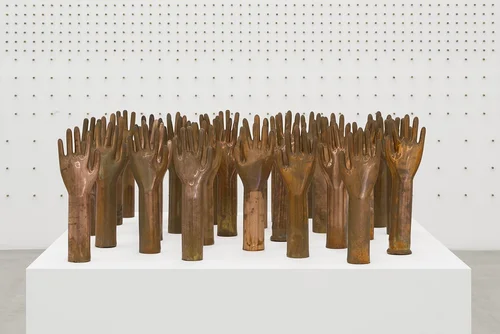
I had been thinking about the Soweto Massacre when I made it, more than 30 years ago. I had received a letter from the San Francisco Arts Commission saying they had awarded me with the Adaline Kent Award, which was a solo show in the main gallery of the San Francisco Art Institute.
Around the same time, a friend of mine and artist, Jane Nicholson, saw these copper hands, which were actually glove molds, at a recycling outlet on San Leandro Boulevard. She said: you might like these; you have to see them. I ending up buying all of them. Then, I had to go to a gun shop to buy bullet casings. You’d be surprised at the people buying guns and live ammunition. It was creepy. I bought cases of empty gun shells, which became the blanket for the flag standing at the end of the copper hands. The hands represent the predominantly Black children who were killed in the Soweto Massacre because they wanted to learn English rather than Afrikaans.
As for the title, isn’t there a song about ‘ten little Indians’? (Songwriter Septimus Winner created a version for a minstrel show of the children’s counting song, called “Ten Little Injuns.” HIs 1868 composition includes a second-to-last stanza that reads “Two little Indians foolin' with a gun/One shot t'other and then there was one.”) I suppose the title seemed appropriate to me because this country is one of the most violent countries in the world. Right now children are being taken from their families are coming home with no parents because of the current administrations polices. I don’t see him sending his wife back or for that matter what doesn’t he leave. We are on stolen land from Native Americans. As an African American, I feel safer walking the streets of Morocco and Egypt at night than I do here. At any moment I can be stopped by the police or if my grandson is driving or walking it is even more threatening. They been stopped for no reason or because they were in a particular neighborhood that the police thought they should not have been.
Your work, “The Magnolia Project: IV” (2008), is intriguing. The way the girl gets embraced and “lost” in the woman’s body; the postures so clearly understandable even without details; and the background with its regimented buttons regimentation and meandering line work.
I worked on this in Italy, around the time of the first of two fellowships at the Rockefeller Foundation in Bellagio. I was influenced by the centuries of mosaic work I was seeing, not just in Italy, but in Morocco and the Mediterranean. The buttons are related to my background in pattern-making and design. So in this piece there’s a convergence of inspiration from ancient mosaics, fabric patterns from my prior studies, and the way contemporary digital tools make it possible to layer images on top of one another. I was drawing from all of these resources, past and present.
When you’re caught up in creating, it’s freeing. In the moment, one idea leads to another. You just have to let your mind be open. My husband often used to say: “Don’t deal with the bullshit — it’s just chewed-up grass.” I laugh about it all the time. I might have to do a drawing of a bull.
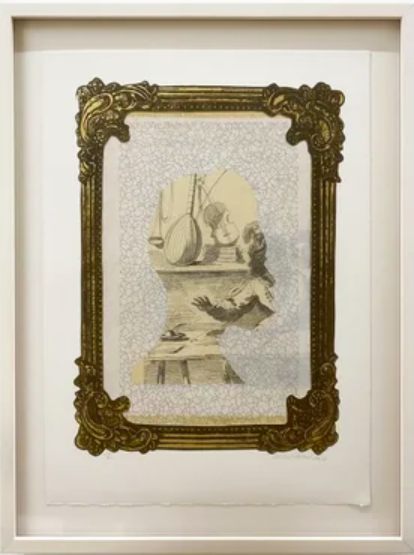
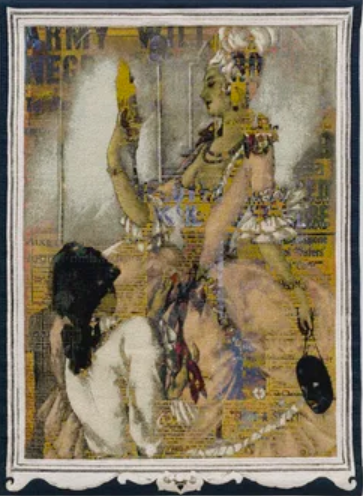
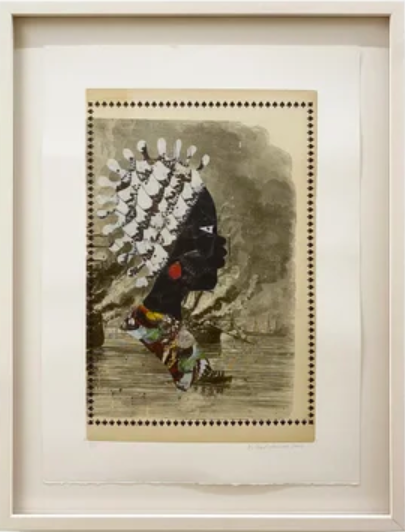
The 27 prints resulting in “Casanova: Style, Swagger, and the Embracement of the Other II” from 2018 has specific inspiration—an 18th-century set of Casanova’s journals—and combines collage, found antique engravings, digital images, maps, various papers, lithography, and chine collé. The work seems highly relevant to issues such as immigration and deportations in 2025.
I worked on that series at Shark’s Ink in Colorado. Casanova’s parents were artists and theater people. These documents were his notes. I think he was exiled from Venice. (Casanova was expelled twice, in 1775 and in 1783). I saw this story and its imagery as a fascinating opportunity to reframe narratives around “the other,” and to look at the ways they’re informed by fear, but also by desire.
In so many ways, this country is still wrestling with the idea of “the other.” The current administration has some nerve, sending people away. All these fake borders that are being put up? It’s horrible. These narratives are everywhere; you see them all over the world, throughout history. The color of the chess pieces might change, depending on who’s telling the story, but the game is nothing new. The truth is that “the other” is what makes life interesting. We’re innately drawn to “the other.” You learn from people who are different from yourself.
Is there time left to talk about two last pieces? “Flying Low” (2006) and “Tha’ Dogg Express” (2021).
Flying Low is two sparrows in a work glove. It positions these fragile birds in the hands of someone who works so hard. There’s a gentleness to it and a balance — the softness of the birds and the strength of the glove that’s holding them, but not crushing them. It reflects an embrace of life.
Tha Dogg Express — I love that piece because of how it speaks to change, movement, and remembering. There’s so much history around us that we might miss, even when it’s embedded directly into the landscape. The Bay Area is one of the most liberal places in the country, but an event like the displacement of Russell City can take decades to be acknowledged as part of the official story. The Western Addition in San Francisco is another example of displacement. West Oakland where I currently live is changing. There are so many things like that happening around us all the time. Sometimes artists are the only ones with the nerve to talk about it. Artists are courageous.
(Russell City was founded in 1853 and boomed during World War II when people seeking work in nearby factories moved to town. Because Russell City was unincorporated, it became a haven for Black and Latino families who had difficulty buying property in other parts of the Bay Area due to racial covenants and redlining. It was home to several blues clubs, showcasing musicians like Etta James, Ray Charles and John Lee Hooker. Without city services, Russell City declined and in 1966, residents we’re forced out of their homes when the City of Hayward annexed the land and opened an industrial park in the area.)
Can we end our conversation with the project you are working on next?
I’m working on my big retrospect at the Oakland Museum that will open in June of 2026. I’ll have something new. I always have a new work in a show. I won’t say more than that, though. Even with an idea in mind, I never know which thread I may end up following, or where it might lead.