Maria Porges
Had there been in 1992 no former architecture student who with artist and writer Maria Porges whipped up blueprints and performed a complete tear-down/rebuild of her 1912 home’s two-car garage, there might not be Lost Knowledge, Bombast/Balancing Acts, Exhortations, Shortest Stories, Mashups 1 and 2, and other series in her vast body of art. Minus a dining room table—let alone a renovated, downstairs writing office with a separate entrance and its own bathroom tucked into the home’s sloping landscape—there would, speculatively, be fewer of Porges’ penetrating reviews and columns written for the likes of Artforum, Art in America, Sculpture, American Ceramics, Glass, the New York Times Book Review, among others. The authored essays presented in over 120 exhibition catalogues, dozens of scripts written for museum audio tours, and her blog, Words About Art, might not exist and continue to with her art to bring her enthusiasm and energy into the public eye.
Fortunately, the in-home art studio and writing office were created and in 2025, at age 71 temporarily back at the dining room and writing on a laptop table, seated, due to a sore hip on a laptop, Porges says in a conversation about her life and work “If I hadn’t had a studio in my home, I probably would have stopped being an artist when my daughters were growing up. It’s also the way I work. I’ll work for two hours on a piece of writing, then wander into the studio and work for a while. I don’t know how people can organize their lives to have a studio away from home so they can go there, work, and then come home.” Retuning to the topic later in our discussion, Porges adds, “Some people can just go on making art, having a career, teaching art, and raising kids. Basically, after my daughters were born, there were long stretches where I was writing or just doing stuff with them and thinking if I’d had a studio somewhere else, I would have given it all up.”
Porges has a bachelor’s degree from Yale, earned her MFA at the University of Chicago, and is a professor at California College of the Arts. Although neither of her parents were professors, they were, especially her research physicist father, “the village explainers.” The conviction she would someday work in higher education began inexplicably during her early childhood. “I can remember at age 10 thinking I would go to college and graduate school, get a PhD, and become a college professor. I always thought it was something I’d do.”
Porges at age 47 became the mother of sororal twins; two now-adult, non-identical 23-year-old daughters. Our conversation begins with the myriad ways that experience influenced her working practices, interests, and philosophies. Porges displays in conversation a fiercely forward-thinking, expansionist mindset; often weaving in historical and personal timelines that did or did not alter directions she pursued, sometimes making a declaration, only to instantly question and speak of exceptions to the very rule or belief she had just asserted.
Please tell me more about your daughters’ influence and amplify the topic of duplication by touching on sameness and difference in collections or series of works illuminated and explored in your portfolio.
Do you have children? I cannot imagine anyone, if they have a family, whether man or woman, asserting their child had no influence on their life as an artist…. That’s not true; I guess some people might be that way. I waited a long time to have kids. I was 47 when they were born. I had no interest in doing what some people do and basically letting someone else raise my kid while I continued working to the same degree I had been. I know other people who have children and continue full-bore with their careers. I’m just not that kind of person.
As for the twin aspect, yeah, having fraternal twins truly is not like having identical twins. Or maybe in some ways it is, as I’ve never had identical twins. But (regardless) if you have a sibling, I always say, imagine you and that sibling coming out at the same time. It is a complete, random shake of the genetic dice. My twins are sisters and therefore genetically closer than anyone else in the world, but they are completely different people. I will point out that they’ve never known life as anything but with that other person. Same sex fraternal twins tend to be closer than male-female fraternal twins…supposedly. I think it just depends on the people.
In terms of influencing my work, they’ve been kind of everything for the last 23 years. At the same time, you can see from my blog posts I have plenty of other interests. I’ve had an active career as a writer, artist, and near full-time academic for virtually the entire time they’ve been alive.
It’s clear you view them as separate individuals with distinct, unique, and contrasting traits, but also recognize them as part of society’s general, “living collective.” Which brings up what could be seen as an inherited urge from your grandmother Mary Löw’s and your father Karl Porges to collect everything from books to painted masks to folk textiles.Many of your works are made from a range of found materials, such as books, window frames, yarn, printed text, and used to create vessels, toys, tools, and so on.
It’s very interesting, I do think of bodies of work as whole groups of things together. When talking to graduate students, they ask me about making work. I have sometimes said, well, you have to be systematic. If I’m making a body of work for a show, I make a list of every piece I think should be included. Under each one, (I list) all the jobs required, the things I need to get, do, or complete, all the way up to the final preparations for hanging. Without lists, I’m completely lost. Even now, I’m trying to figure out the ceramic pieces I’m making. I’m finding they belong together in groupings. In the recent, two-person show we just took down, in thinking abut how to present the pieces, I find that I never think of them as by themselves.
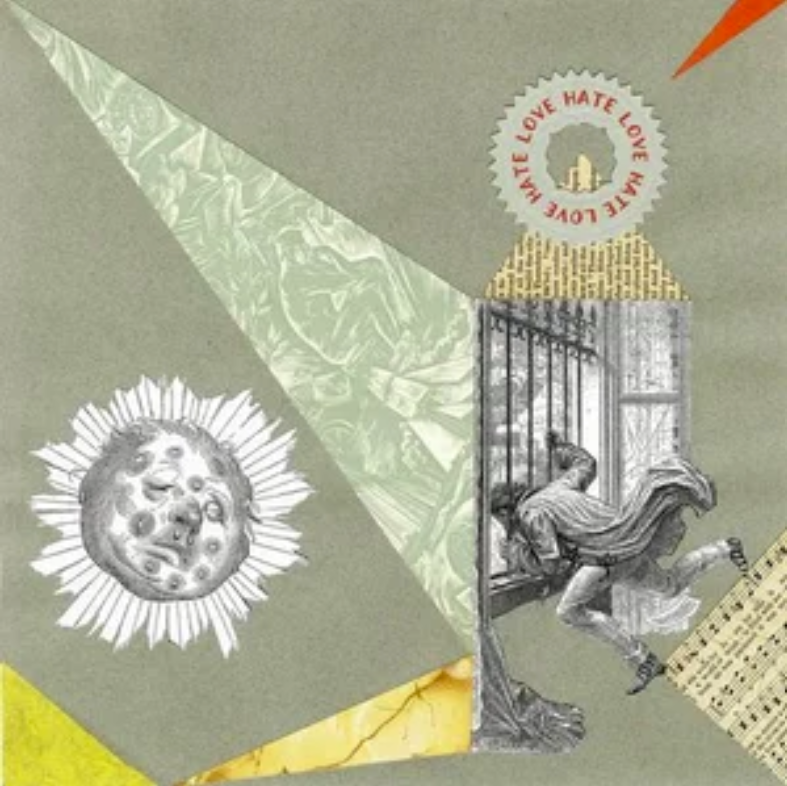
I was definitely part of what some describe as the Bay Area movement of artists who worked with materials combining the found and the made. There was text in my work for long time. Someone asked me recently, “Where did the text go? Why is it no longer part of the work?” I honestly have no idea, but I’ve been thinking about it. I’ve also been thinking about unmatched twins in the context of some of these ceramic pieces. But my motivations and desires are different than what they were when I was 40 or 50.
Was those years a time when you cared a great deal about how your work was perceived…why, and what is your perceptive now?
Well, yeah, I was in the thick of it. I wanted a successful career and I did that. I discovered it’s not necessarily as satisfying as you think it might be. There are many external factors. A friend of mine, a painter, knew she would die soon from cancer. She felt urgently the necessity of explaining important things she had learned to as many people as possible. One of the things she told me as well as several other people was that she wished she had some way of explaining to students that part of the reason being an artist is so hard is it’s so unpredictable. If you’re a decent accountant—although now, I feel there’s no security; even programers are getting cut from big tech companies—you’re likely to earn the same amount of income every year. But if you’re an artist, that same income line looks like crazy ups and crazy downs. You can be successful, nationally known, and five years later, nothing.
Coming up in the art world, I’ve witnessed several boom and bust cycles in my lifetime. The first one was at the end of the 80s. There was a sudden dead drop in the art world. I was writing for several art magazines, though it was not what you’d call gainful employment. I’ve always thought writing reviews was my service job in the art world. But basically, a bunch of those magazines went out of business, including Arts Magazine, which had been going since the 1920s. It was the first time I realized that being an artist was not stable or predictable. You have to be doing it because there’s nothing else you can do.
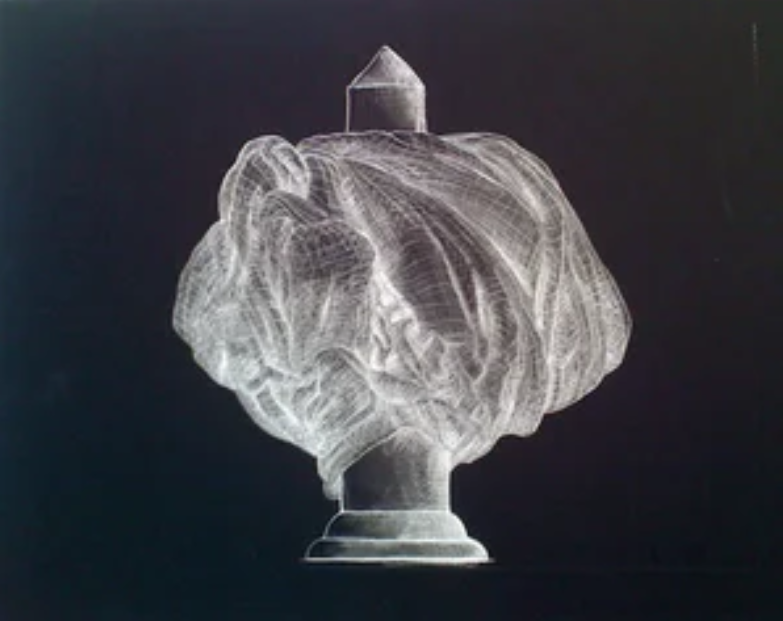
Moving our conversation to specific pieces or series of works, what thoughts come to mind when we begin with “(c)hair; 2012,” the piece at the Floating Museum that is part of the LOST KNOWLEDGE series. In one of your essays, you mention having an “obsession” with hair. It would be interesting to learn the origin of the fascination.
The beginning of the year that piece dates from, I decided to start a new project. I needed to do something completely different from my previous work. This is going to sound funny, but I thought, ok, how about drawings made with ink and brush, which I’d never used, on very smooth, hot-pressed paper, and an 8-by-11 inch scale. Why the hair? I’ve just always been interested in the sexuality of hair. I started (that series) making memorial wreaths. They were drawings that had words in the center of them. That expanded and I can’t remember how it started but I made drawings of three different chairs; a Louis XV side chair, an armchair, and the chair that Marta bought for the museum. I was interested in just the idea of it and even made a drawing of a full-size couch made out of air. That one was very unsuccessful. I was just trying to figure out what to do next.
The hair came back again when I had a show in the Gatehouse Gallery at the di Rosa (Center for Contemporary Art). It included many drawings of these little girls with giant hair. I was thinking about all of that stuff that happens to us as we’re educated—about the disaster the Enlightenment represented for intuitive, so-called female” thinking. The same idea that Peter Thiel is trying to bring back that women are inferior intellectually. They don’t need to vote or have jobs that men can do for them, because men are more rational.
As the mother of daughters, you start thinking about that stuff as you see them navigating the world. Having children really made me remember and review my own experiences of the educational system and life in general. Try daughters are way more adept than I ever was. Not sure if it’s a credit to them, the schools they went to, or the fact that I’m much more attentive as a parent than my mother was. We try not to repeat the mistakes our parents made….That’s not true, because some people are happy to repeat them because they don’t see them as mistakes. That whole show was me trying to figure out how they and women in general navigate the rational world. It’s a place that’s essentially hostile to the intuitive.
The Bombast/Balancing Acts series, among other aspects, seems highly tactile—a person wants to hold each piece to feel the texture and weight, for example. What is the story behind those works?
This whole body of work was my last show at John Berggruen Gallery. It revolved around a dream I had that I made into a short story. It was about a woman who’d been part of a group who’d bombed a building in college. She’d been underground ever since. At the funeral of her favorite professor, she sneaks in wearing this ridiculous disguise. She meets up with a fellow who seems familiar to her. She realizes in one of the story’s last seconds that he’d been one of the bombers but his identity had been kept secret and he’d been able to keep having this life, while she’d had to take a series of jobs like washing dishes, ghost writing, rather than having the life of a public intellectual and the life she’d wanted.
I just started making those bombs, out of wool, wax, ceramic and glass. They look like the bombs that Wylie Wile E. Coyote buys from the Acme Bomb Company Corporation in the Roadrunner cartoons. I did not knit the bombs that are part of the large piece titled Bamboozle that was the centerpiece of the show. I’ve learned to knit three times, but it doesn’t stick. I’m good at sewing, but knitting eludes me, probably because I’m so strongly left-handed. I found a knitter and a pattern. She would knit them and I would felt them, stuff them, and (add) a fuse. Eventually, I made over 100. BAMPFA owns that piece. I hope someday they show it again.
The irony is that the week or week before my show opened, our dear President Bush declared war on Iraq. So bombs were not a popular theme. I sold some of those pieces, but not most. The other big piece in that show was a clock made of blown glass vessels that are meant to look like Molotov cocktails. The text on each says something like “hand to hand, mouth to mouth, door to door.” It’s surprising how many of those (phrases) seem to refer to combative situations..
It’s hard to explain how I ended up choosing to make all of this work. Once I’d started, I knew I had something and I just kept going. My relationship to material has always been intuitive. I’ve made sculpture out of a lot of different materials.
Is your focus in a series of works similarly led by intuition? In what ways do other artists’ work and “external” forces such as thoughts on the female form represented in art and literature serve as protagonists? Perhaps the Con/Re/Straint series is a jumping off point?
This series has to do with very specific impulses. When I was a teenager in Chicago, the artists in the Hairy Who and the Chicago Imagists were artists widely shown there and virtually unknown anywhere else. That was because of the parochialism of the art world in the 1960s and 70s. New York looked down on anything but New York. Chicago and LA had their own, native art scenes, but they were very small.
One of the Imagists was a woman named Christina Ramberg—there’s been an interest recently in her work and a big retrospective of her career that traveled. I went to LA to see it, but I’d already obtained the catalogue from a European show that preceded this one. I’d studied the catalogue and remembered looking at her work when was 14 and finding it off-putting. Years later I discovered there’s something deeply interesting in the gendered nature of her work. For Ramberg, the image of the body in restraint was a central theme. Many of her paintings depict partial views of torsos and bondage as corsets. I started thinking about trying it out in my own work. The pieces start with obvious homage to Ramberg’s paintings, but evolve as they become more abstract.
The one I’m most interested in right now is one that looks like a ring shape, partially wrapped, with some areas still visible. All of these things I thought of, again, as hair being wrapped and constraining. That’s what it looks like to me. I don’t really care if it does or it doesn’t to other people. The pieces you see on the website are just me, trying to figure out it out.
Jeanne Silverthorne is a second artist I admire. She did an exhibition of work that was all on casters. So, sculpture you can roll around the studio to get them out of the way. I’ve often thought, that would be great. If everything was on casters, it doesn’t wouldn’t take up so much room. Now, I need to add two more shelving units in my studio or throw out more stuff.
Is sculpture’s take-up-space, physical presence a struggle beyond the studio?
Have you ever noticed in commercial galleries there’ll be twenty painters represented and one sculptor? There’s a reason. It’s much easier to get someone to hang another painting than to get them to displace furniture to accommodate sculpture. During the most commercially successful part of my career, many of my pieces consisted of objects presented on shelves and cabinets that hang on the wall. Sculpture is a harder sell. That’s not going to stop me, but I do go back and forth between things on paper and objects. The vast majority of my drawings are of things, but not necessarily things I’m going make. Like I’d never make a life-sized chair out of hair, because it just wound’t look as good as the drawing. But I want people to think that it could exist, so it’s portrayed in a compelling way.
For people viewing your art, what might you say about perception and vision and the variations in general and within the context of the Shortest Stories work?
To be candid, I’m realistic. Early on in one of my first pieces, something called “Blue Rice” that’s not even on my website, refers back to something I learned while studying with a potter in Japan. (After college, Porges went to Japan, where she studied with a potter for a year.) In one of the texts in the piece, I wrote about how I have no way of knowing if, when you and I look at the sky and say “blue,” if we are seeing the same thing. Even the most basic of our experiences-- we simply have to assume that we share them.
I’ve always wondered what it means when someone describes something as conceptual. All art is conceptual in that there’s an idea that motivated its making. For me, the material has always been important and I’ve been so interested ii making something beautiful that when somebody described my work as conceptual, I thought it was hilarious.
When I was leaving college, trying to figure out what to do next with my life it was the mid ‘70s. There were people like Mel Bochner running a tape line around a gallery at MOMA. On the tape he wrote numbers going in one direction from one to two thousand-something and, in the other direction, the same numbers in red. This was considered to be a great work of conceptual art. Now, I don’t deny its artistic value, it was just not the kind of thing I wanted to be doing. I didn’t want to be a painter, but I didn’t want to do this other stuff either. That’s part of why I went to Japan. I was just trying to figure out what comes next. As poet Stephen Dobyns says, to figure out what comes next and how to like it.
Are you finding it and do you like it?
I’m 71. Right now, I feel despair. I’m at the point where my death could be tomorrow or in another 20 years. But for my daughters, who are just starting their lives, I feel despair because of everything going on. I ask myself, is there justification to continue making art and writing art criticism? Or is this fiddling while Rome burns? Some people believe its important to keep on making art because it’s important to keep culture going. Sometimes I think I should work harder to be a social justice warrior. But I also know there are some things I’m good at and calling people on the telephone to try to convince them to convert to my point of view is not one of those things. Also, there’s not much chance it’s going to work. The only thing that’s going to convert people to give up believing the idea that snatching people off the street and deporting them is a good idea is if something happens to someone they know, who is not a bad person.
It seems unlikely the only emotion/topic you experience is despair. What lifts you from the doldrums of reality now, in 2025?
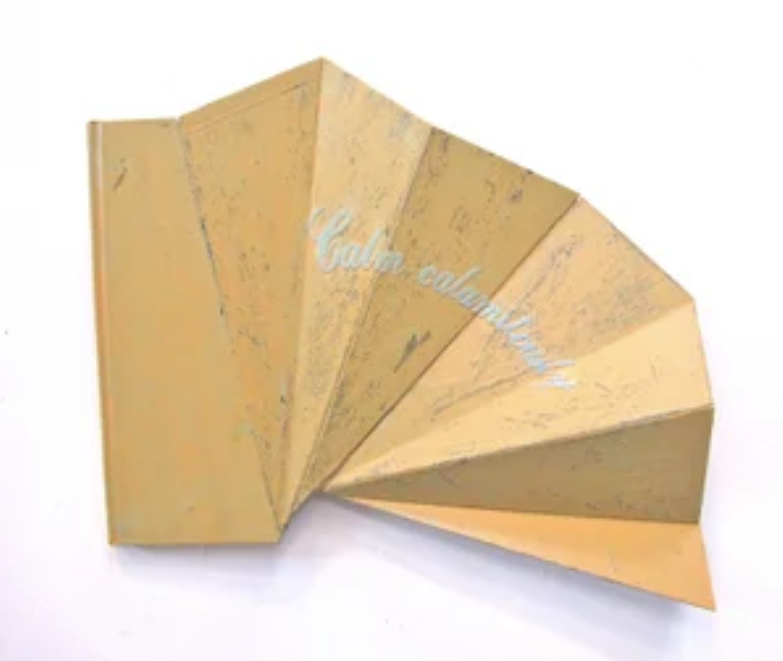
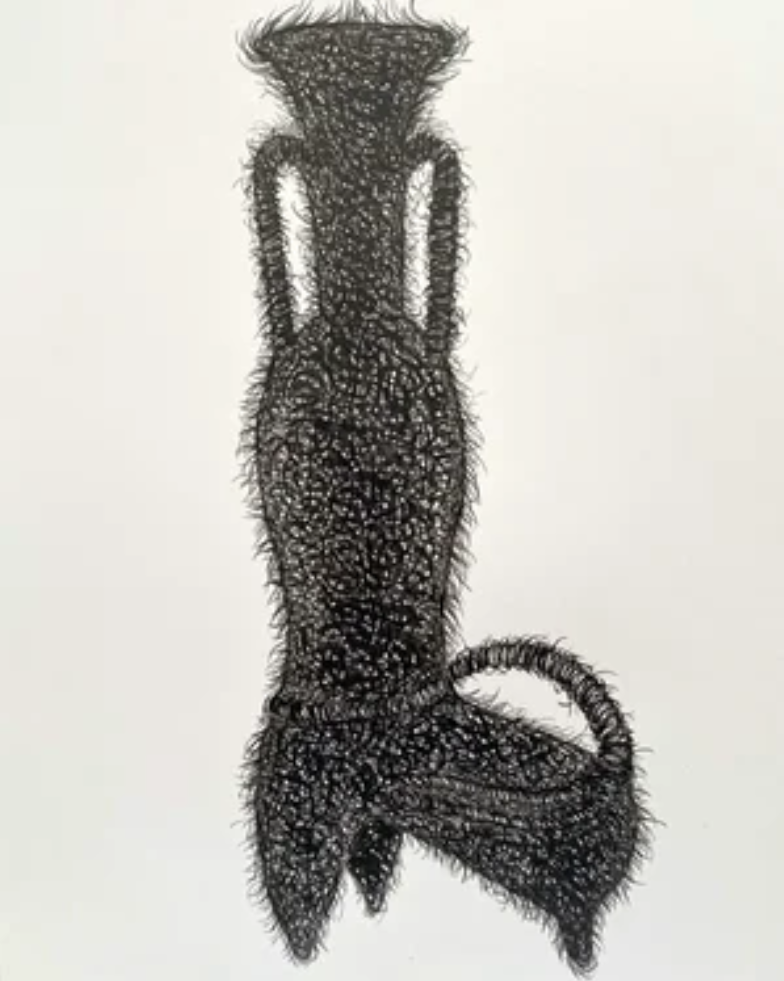
Collaging different shapes together. If you look at the sculptures on my website that are a combination of axe or tool handles with a book component, that’s a combination of shapes. Even with the cast wax bottle pieces, those bottles didn’t exist. If I found (a shape) I wanted to be bigger, or shorter, I had to make a mold, cast it, cut it up and reconfigure it, make another mold. Imagine a behind-the-scenes toymaker–me–making things do what they do as seamlessly as possible. The vessels I make now? You have to know something about ceramic history to get the joke, but they're hilarious to me in the way they combine various traditions together. Plus, many look like they’re living beings. Do I do that one purpose? Yes, I probably do. Many objects in our lives have their own secret lives. I often think of things as being animate.
In the prior response, you mention the Booktools, Toys & Weapon series. In an essays you have written, “I investigate the way our relationship to learning is increasingly simplified and categorized, into that which is useful, pleasurable, or can be wielded to some kind of (personal or group) advantage.” What primary things does that bring you to say about art education today?
I can’t tell what’s coming. As with all higher education, people are asking themselves what a college education is for, what do you learn? For some people, it’s giving a person the tools they’ll need for a career.
I met a collector some years back, here in San Francisco, who was in tech and had been one of first people in Apple, then cashed out. He owns two houses, one that is just for his collection. That’s the kind of money he has. He was sanguine and said it’s ridiculous to think that people, once they make a lot of money in tech, start buying art. He described his childhood and young adulthood when his parents took him to museums and the opera. His parents educated him in culture. He said it was a good thing they did because once he went to college, he did not take a single course that didn’t have to do with technology and programming. His point was, if he not had that experience with his family, why would he have turned to collecting art?
The problem with viewing education as purely instrumental in terms of a career, is that it doesn’t address curiosity, being exposed to stuff you’d never would be otherwise. Why take an art history class or a literature class? I don’t know what’s going to happen, but I see that having students graduate prepared to go to work has become of increasing importance. I have no opinion about what the best education is. I don’t know if anybody knows.