Carol Law
When multidisciplinary artist Carol Law, age 81, was growing up in the 1950s in a small town in Texas, she began in elementary school to learn gender matters. Boys had privileges, exciting lives, access to careers full of adventure, risk, and achievement. Girls were funneled into roles that included marriage, children, and no careers other than homemaker. By high school, she observed pervasive discrimination that had grown like weeds in an untended garden and applied to all age groups. Girls were not allowed to take trigonometry or encouraged to pursue higher education; her mother and her mother’s friends chose not to work outside their homes because it would embarrass their husbands and cause gossip suggesting the men could not support their families financially.
Upon graduating from high school, Law rebelled, encouraged by one high school English teacher to burst from the domestic tunnel by attending and earning a bachelor’s degree in art from the University of Texas in Austin. Bolstered, believing her world was expanding, she set her sights on graduate school. Law’s plans were dashed by her father, who said her younger brother had to go to law school. His education would take all the savings, and besides, she was supposed to marry her boyfriend.
During a conversation (featured in the Q&A below), Law says, “I wasn’t interested in that at all. I tried to apply for graduate scholarships, but I wasn’t able to get one.”
Instead, having at university studied painting, drawing, and color theory primarily with professor Robert Levers, a protégé of Joseph Albers, Laws took off for Europe. Landing a job and visiting museums and art venues in various countries, she encountered the art and philosophies of Dada and Surrealism. Importantly, she discovered there were not only men, but women surrealists. Between 1965 and 1968, this fact, and the experience of living in Germany only 20 years after the end of World War II, proved revelatory. With her background studying abstract expressionism, she was exposed to the actual surrealistic, ghostly ruins of buildings and public spaces that had been destroyed in cities, towns, and villages. Among other riveting experiences had while traveling, Law recalls visiting Dachau Concentration Camp Memorial site the week it opened to the public. This part of the education of Law was anything but conventional, cloistered, or constricted.
Returning to the United States after two years abroad, Law completed an M.A. in Studio Art at San Francisco State University, studying with Dennis Beall, John Ihle, and Robert Bechtle. It was there she met her husband, composer Charles Amirkhanian. Together, their personal relationship extended into a professional partnership resulting in over 18 collaborative art performance works that juxtapose Law’s art with Amirkhanian’s text-sound compositions.
Law’s lifelong lust for learning is evident in her 15 years teaching experimental printing techniques at multiple universities, receiving a Masters degree in Clinical Psychology from John F. Kennedy University in 1987, serving for four years in the mid-1990s as General Manager of the Djerassi Resident Artist Program in Woodside, CA. and other academic pursuits. In her paintings, prints, photographs, mixed media, and performance art, she merges early influences—Dada, Surrealism, Pop Art and Fluxus—with new technologies. Her body of work provides penetrating insights grounded in history and facts, often tinged with savvy humor. By embracing the imagination to comment on female identity, the environment, and culture, her work over decades remains vibrant and contemporary.
Law has exhibited works at the Cooper-Hewitt Museum, San Francisco Museum of Modern Art, San Francisco Art Institute Gallery, Allende Museum (Santiago, Chile), Den Haags Gemeentemuseum (Netherlands), Belca House (Kyoto, Japan), The International Museum of Photography (Rochester), and the Visual Arts Center (Anchorage), among others.
Please begin with describing your early history and the term(s) you use to describe the artist you have become.
I do not call myself a surrealist. I consider myself a post-realist or a person informed by surrealism, but I am just as informed by many other art movements. In performance art, I’m very influenced by Fluxus, for example.
My mother and I started drawing together when I was about six years old. She was a self-taught, interested person in art. At 13, she found a painting teacher in a nearby town. I studied with Mrs. Boyd in her garage. I went to a small junior high school with about 100 people in my (grade) and we had no art program at all. My influence was really from my mom. It was the 1950s and art was just not taught.
Mrs. Barnes, my high school English teacher, was a big influence on me because she respected me. She thought I was intelligent and had better things in my life. She encouraged me to go to college, said I should be in journalism and be a writer. Mrs. Barnes gave me respect as a female. She respected that I could do whatever I wanted to do and do whatever boys could do. I was a good student in high school; made straight A’s, (but) I’m talking about the beginning of feeling the culture was forming the life of a girl due to gender. Boys were being formed to go to law school, work in the dad’s auto shop, whatever. Girls just needed to find a guy—as soon as you could.
Please talk about your college experiences—including meeting Stravinsky—and how they contributed to your practices and identity as a professional artist.
I was always a bit different. In high school, I just wanted to leave, to get out of town. It was a very wonderful town in many ways. You felt held by the community. All the people and parents took care of each other’s children. All the adults knew what you were doing; but there was not a lot of privacy. I didn’t like that. Going to the University of Texas in Austin was an escape. It was a school of 40,000. At the time I went, it was the same size as UC Berkeley. I struggled a bit my freshman year, and then I got into the art department and was so happy.
I met my first, really important influence, professor Robert Levers. He immediately supported me. He said, “You’re one of my best students, you have real talent.” It just floored me. I had a great four years studying art and meeting artists. It was a big school and had a lot of money. They brought to campus Louise Nevelson, and Jacques Lipchitz from France. I was in a music appreciation class and I met Stravinsky, which made my husband, Charles, really jealous. He was elderly, but they trotted him out and he talked about his work. He was almost 90, a very old man, and those of us who wanted to meet him could come up to the front (of the classroom). I didn’t say much, I think I mumbled something about loving his music. That was my stunning introduction to music.
Speaking of music, what defined and lay the ground rules for the collaborative projects you’ve undertaken and continue with your husband?
What is important is that my part is respected, the other person’s part is respected, and we put it together without trying to change each other. I want to stay pristine in (my part)—like Merge Cunningham and John Cage did. The juxtaposition itself makes it interesting. This is my approach. I would not suggest it to others. Many people like to see their work morph and change. I was never like that.
Does that mean you never provide commentary on the other person’s part?
Charles and I do give each other feedback. There’s a right kind of feedback you can listen to that’s helpful to you. Your central self (remains). I might have something and Charles says, “I don’t know about that composition: are you committed to that particular photo?” I might think, that’s right, maybe another photo would work. I give him the same feedback. He and I may change something, or we don’t. We both collage, montage, and work with our materials in very much the same manner; only his are in music and mine are in visual art. That also made collaboration a lot of sense.
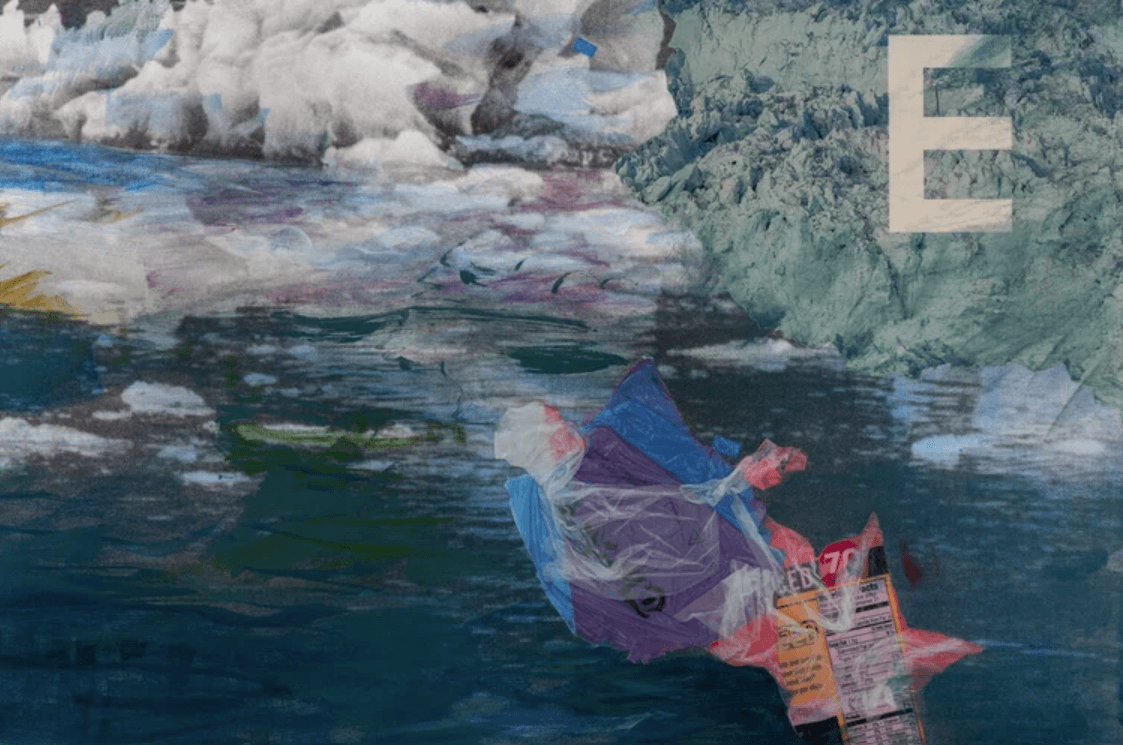
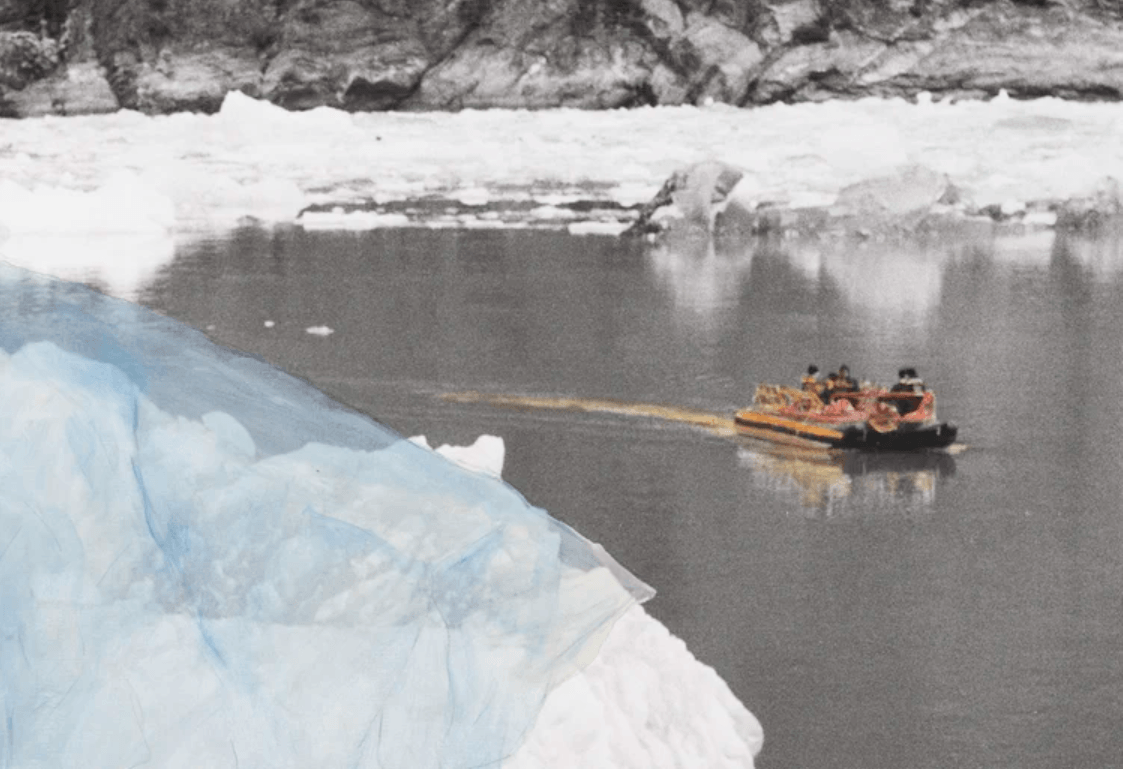
Will you reflect and comment on several works selected from your portfolio? I suggest we begin with the origins of two works included in Floating Museum’s Rising Tides exhibit: Sitaaantaagu Glacier, Status: Retreating #1,Sitaaantaagu Glacier, Status and Retreating #3. They are large, mixed media paintings, each 28 x 40 inches, about which you have written, “This series, completed in 2019-2020, are a meditation on the melting of the earth’s glaciers and the frightening amount of human garbage filling our oceans.”
I’m in Alaska on a vacation. I have my camera. I am just appalled this melting has happened so fast. I’m upset, thinking about the environment, talking to the local people about the glacier. [“Sitaantuaagu” is the native Alaskan Tlinkit name for the Mendenhall Glacier located near Juneau.] I’m talking to (indigenous) Indian women in the library telling me about what a spiritual place it was. I photographed it and just kept the photos in my files for years. I found them later and thought, I’m ready now to use them because things have just gotten worse and worse in our environmental situation. I was wanting to do something that engaged thoughts about what was happening in the larger picture of our world.
I read an article at the same time about how we’re shipping our trash to countries in China and Bangladesh. Women and kids were sorting through piles of trash. There are pictures collaged in (to my art) from some of those articles. They’re cut up in little pieces and thrown in. I printed my photos, large, on canvas, in black and white, and then I worked into them collage and painting. I’m always interested in the formal elements of color, design, composition. The series is those traditional elements with a narrative about trash we’re throwing in the ocean and melting glaciers. It’s not a literal statement, it’s my subtle observations and curiosity to explore one of the things happening in our world today.
Moving to The Trawler Epine, An Icelandic Allegory, which centered on iron artifacts preserved on a beach that are remnants of a British Trawler, the Epine GY 7, which wrecked on the Snæfellsnes Peninsula east of Dritvik on March 13, 1948. Of the 19-member crew, only five men were saved.
There’s often a narrative going on in my mind when I work, but I don’t illustrate it. I come across something in nature or things in my life that so strike me that they become a narrative. That was the situation with The Trawler Epine. I went to a particular beach in Iceland and these rusted pieces of a ship were still on this black gravel that is made of lava from volcanos. They were beautiful red, rusted pieces from this ship and I photographed them. I often have my camera with me and picked up photography while printmaking. I brought the photographs back and read the story of this shipwreck and the men on the ship when it was going down. It was so icy cold, they could’t go out on the water and it was a terrible storm. I wanted to share that narrative, it impressed me as a human experience. The strange, eery beauty of these pieces on the beach were the story. The area is now a national park preserve, meaning no one can pick up those pieces. They are art. There’s respect for art in Iceland.”
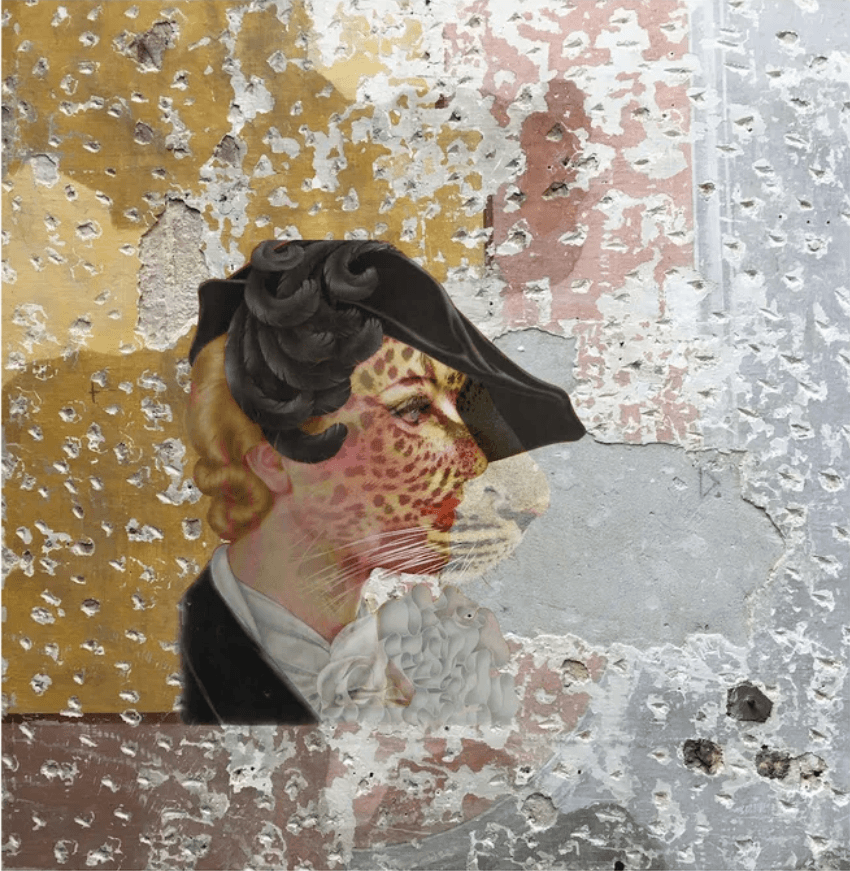
Respect for art and artistic spaces appears also to be an element in Fortuny Walls, a series of six works using source images including your original photography and printed graphic materials altered using digital media. The title refers to the interior walls of the Fortuny Palace in Venice. What about the work’s source material determined the direction you pursued?
In some ways, it started the same way (as Epine). I had my camera and went to the biennale one year. At an exhibit in the Fortuny Palace, they had ripped what were probably (old) paintings on the walls off. This revealed what had been an ancient wall that was hammered and plastered. Instead of looking at the exhibited biennale art, I photographed the walls. I just fell for them, for the history and what went on there. I brought the photographs back and had a strong feeling for those walls and the people who lived there. I worked with them in the sense of surrealism, collage, and whatever came into my subconscious. Other influences came from the 20th century. You see (in my portfolio) I work a lot with early magazine imagery of women. I have a huge amount of work using 1950s and 60s women’s magazines and the way women were presented in advertisements as little housewives, making things, working with laundry.
in addition to your photography as a primary material, do Epine and Fortuny Walls share thematic aspects?
Yes. It is the deterioration of an idea, a history. Something interesting that at one time had a life and a story. The deterioration and restoration of this room (at the biennale) is the cycle of life. There was beauty in the color, texture, and formal elements of those walls. I couldn’t have made those walls. They’re a found object. That’s also what happened with the rusting parts of that ship. I often photograph found objects and use them in my art.
If we go back into your archives, will you share your comments on The Volta Notebook, a drawing series created on site at Tempio Voltiano in Como, Italy?
(With this series), I’m living in Europe. In Como, there’s a museum that has the work of (inventor/scientist) Alessandro Volta, and all the things he explored. He built the first battery. I was captivated. There was the narrative of him—married, creative—and there were these little sculptures made from leather, blown glass, wire. One (device) actually fried up a little frog; running up electricity to see if it would survive, like a torture device. It made me think about how Americans had used torture on people. The fascination was these objects that carried history and narrative. At the same time, they were sculpturally special. I photographed them and embroidered watercolors inside of them because I wanted to capture them beyond the photographs.
Sea Ranch Hut and Horse: What motivated the photographs upon which these archival prints from another series were made?
Those pieces came from photographs from several trips to Sea Ranch. I have a huge photographic collection of cliffs, rocks, pieces of driftwood. People there had built little huts back in the trees using little pieces of wood. I was interested in the connection to nature, how wonderful and powerful it is, and how we’ve come to abuse it.
I often photograph something thinking maybe I’ll use it for a setting, like I did with the Fortuny walls. One of my interests is how people have used rock and carved images, including themselves, and made steps, buildings, houses, and castles out of rock. I’m fascinated with the hardness of the earth and how humans have interacted with it to make images of themselves and their cultures.
Gothic Songs: Cave Dancers? What might you say about the techniques used?
(The 14” X 20” work is Kodalith transparent film, collage, and Gouache paint.)
This was done in Italy, in Bellagio, in a cave on top of a mountain they used to drive carriages and horses through. The history fascinated me. The cave is probably from the 15th century when they dug it for the horses to go through. I feel I can use any of my learned skills and interests in every piece, so everything goes, in terms of what I put in. My pieces are very personal. They’re really about the female experience, my experience as a woman. They’re unconsciously geared, surrealistic, letting things come up from my unconscious. Then I find there’s a pattern left: like images of women having struggles in different settings. I use collage because I like to use images of women; the way they were presented in media is a statement itself. Look how we look. Look how we were, Look what they’ve done to us.
Someone asked me, “Why are you never painting a portrait of yourself?” I realized I never paint portraits of women; never draw them. They’re always chosen from images I’m drawn to because of what I experienced in childhood about how women were supposed to look and do. It is my way of controlling and managing that. That’s where the feeling runs through my work. From the beginning of my own sense of my feminist self, I take command of my image, my situation.
I also tend to have a curiosity about something, explore it, connect to it, and then do a series. I do 5, 10, 15 pieces until I begin to feel satisfied and I quit. As an artist, I am curious, which is important to me, so I then turn to something else. Some people say my work doesn’t look all the same. I say, I don’t want it to.
That provides a wonderful ending—almost—to our conversation. Will you indulge one more question; about the insights you have after having been an artist for decades? You have seen multiple art movements arrive and then last, fade, or completely vanish.
Thoughts very specific to my work and being an older artist; you are right, the fact is that I’ve been through many movements in society and culture. I’ve traveled extensively, lived in six countries in my life. I really think of myself as a child of the 20th Century and an adult of the 21st Century. My art is an extension of the self. It’s true of all artists. It’s part of your ego. I’ve always expressed myself through my art and picked up influences from culture, art, and art movements. It comes out in the end influenced by color theory, surrealism, performance and conceptual work. I’ve been around a long time—maybe too long—so yes, I’ve (seen) and done a lot of things. I look at my life and I’m kind of amazed by it.