Ana Teresa Fernández
Ana Teresa Fernández Q&A- HATF Project
Born in Tampico, Mexico, Fernández migrated to the United States with her family at age 11. She grew up in California and currently lives in San Francisco. Her work includes painting, sculpture, photography, video, and performance art. In Fernández’s artwork, installations, performances and collaborative community projects, stories most often address identity, the environment, the land, politics, history, and especially, the connections and divisions within them. She characterizes her work as “Magical Non-Fiction,” apropos to a portfolio grounded in gritty truths and realities that rises to transcendent levels of illumination, imagination, wonder, strength, and awe.
Fernández has participated in residencies and public work in Haiti, Brazil, Spain, South Africa, Cuba, Mexico, and throughout the United States. In one project that received considerable attention—Fernández wore a tango dress and high heels while at work—she altered the border wall between Tijuana and San Diego by painting a portion of a wall sky blue to create an illusion of a hole. Seen from afar, the aftereffect messages escape, freedom, the infinity of outer space.
Fernández’s work is in the permanent collections of, among others, the Fine Arts Museums of San Francisco, California; Indianapolis Museum of Art, Indiana; Blanton Museum of Art, University of Texas, Austin; Denver Art Museum, Colorado; Nevada Museum of Art, Reno; National Museum of Mexican Art, Chicago, Illinois; Snite Museum of Art, Notre Dame University, Indiana; The Cheech Marin Center for Chicano Art, Culture & Industry, Riverside, California; and the Kadist Art Foundation, San Francisco, California and Paris, France.
Let's begin with your name, a topic you’ve told me is terrifically personal and also immense. Why is being addressed by your full first name essential to your personal, professional, and ancestral identity?
It rubs me the wrong way to be called Ana, not Ana Teresa. It was one of the things that occurred when I moved to the United States from Mexico. I lost was my name. When in school I said Ana Teresa, I remember teachers said, “No, you will not go by Ana Teresa here. You will just be Ana.” It was the first thing to go.
Does this reductive experience connect in your body of work to close listening, to being attentive to your materials, processes, inner muse, and equally alert to the voices of communities and artist you engage as collaborators?
That’s where it all begins. There are so many marvelous statements and quotes I can refer to. Mary Oliver, “Attention is the beginning of devotion.” Aristotle, “Wisdom begins with wonder. All these are the way we become intrigued and informed: by paying attention, listening, becoming curious. When that happens, we put ourselves in the unknown, in other people’s shoes, other people’s stories. Until then, we can’t make connections and there’s only apathy. You say to yourself, “That story doesn’t belong to me, it’s not me.” But in reality, it does. What affects one person likely affects a lot of people. It’s like Angela Glove Blackwell says, “collateral benefits.” What is good for one will end up becoming good for many, will benefit many. It begins with paying attention.
I’m thinking about “Pillars of Strength,” an installation created in 2012. Is that a good example of how listening is woven into many facets of your projects?
Yes, it is. I was invited to do this residency in Belalcázar (Córdoba, Spain) a tiny agricultural village with about 3,000 people. The beautiful, ironic, strange thing about the residency location is that it is in a convent. It’s split with half inhabited by nuns, half the art space. I usually bring materials and ideas I want to work on that get me into a mental space of art-making. Then I let the actual space dictate what I want to do.
Toward the back end of the building, was an area you’re not allowed to go into because the roof is sagging. It’s very beautiful, but you can’t access it because they don’t know when the roof will collapse. You can see ceramic tiles sagging in the open courtyard and in a corridor on the second floor. They were trying to get funding for it and I was thinking about history and these nuns, these women who uphold the Church.
In Greco Roman architecture, there figures that are the columns that hold up the structure. I thought, what if I use my superhero costume and performance persona and stand in a bucket and hold up the ceiling. I did it and was photographed. Then I drew myself on the wall wearing heels and standing in this bucket. It was a metaphor for how contemporary women are upholding creation in the art space. And on the other side, there are these nuns.
When the nuns saw the work, they flipped out. They said it had to be painted out immediately. They said we don’t want that type of woman on our church walls, or holding up the roof. The art center tried to keep it from being erased, but the convent had the last word. They went to city hall to fight to erase the mural. This happened at the same time that “Erasing the Border,” another piece I had done, had been (over)painted black by the government. It was remarkable to me that I had two pieces censored at the same time and they were both about borders.
As someone who has clearly thought deeply about divisions that exist not just between countries, but between histories, political movements, cultures, and individuals, please share your insights into how this influences the literal borders of your work such as the way edges are handled in a painting, or how a photographic image is framed/cropped.
I’ve never been asked this and I’m digging this idea because one of the people I admire and learn technically by studying is (painter) Wayne Thiebaud. He’s all about edges. There are also philosophers and mathematicians who talk about edges and scientific aspects of edges. There are dividers where (real and metaphysical) space touches another space, there’s always a half-of-a-half-of-a-half, and so on.
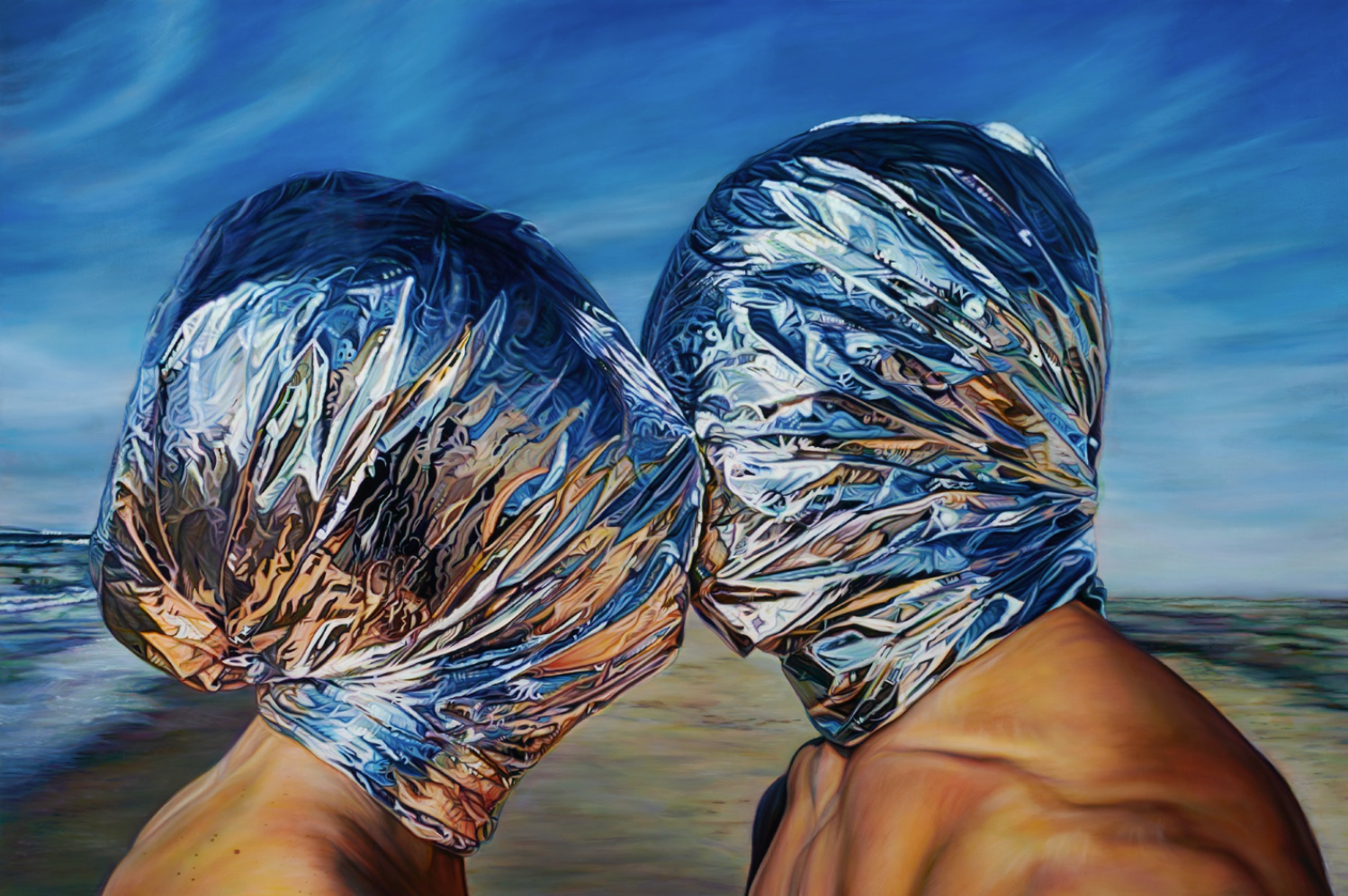
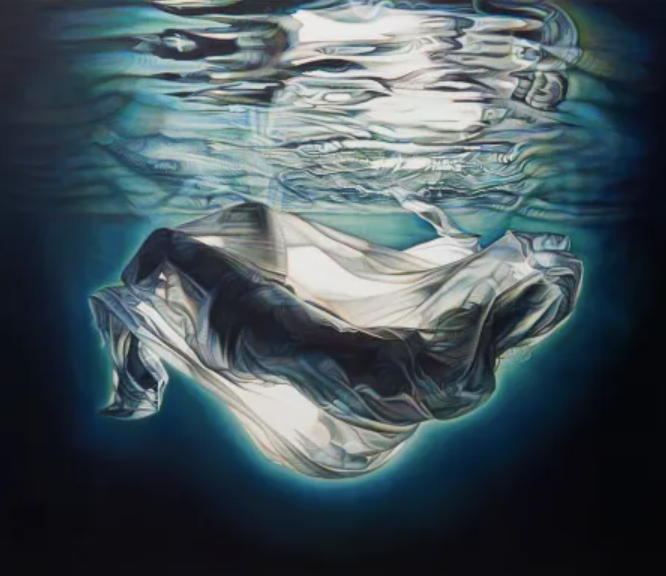
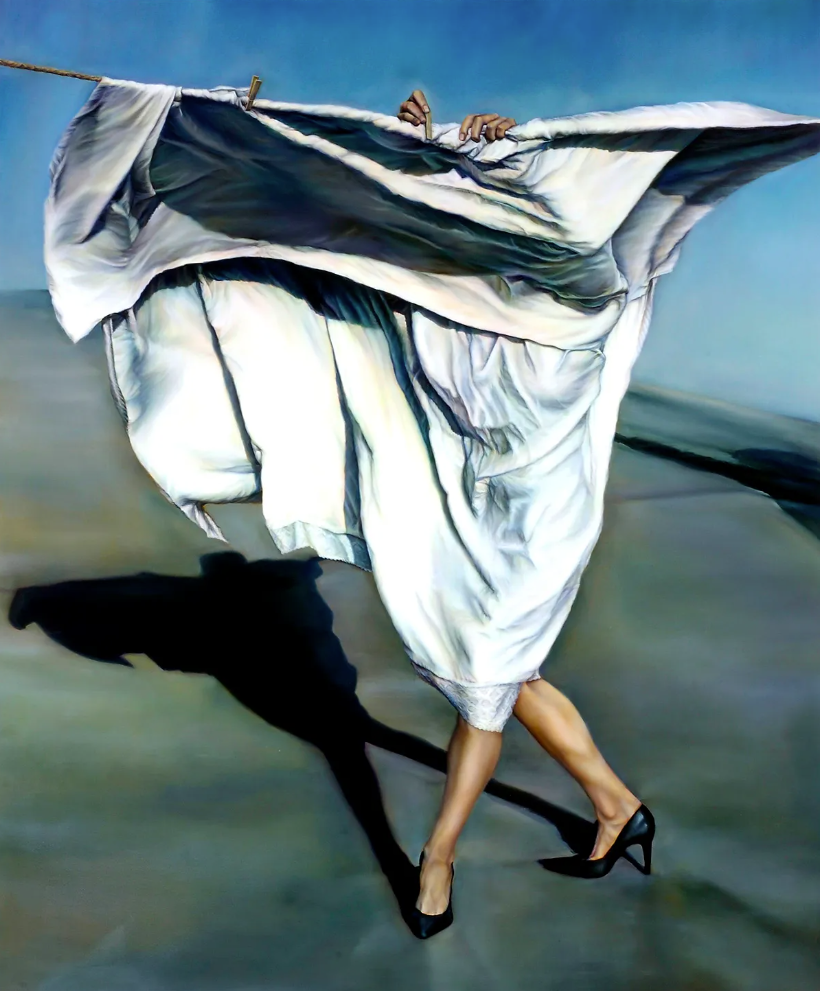
In my work, I’m obsessed with aura and light and fascinated by darkness and the reverberation and translucency where the dark hits the light. Edges allow movement to exist in a still image. I work hard to make sure the reverberations belong. Technically, how I do that is thinking about that when I begin. There are about 50 layers of paint in each painting I do. I think of the end, but I start at the very beginning. There could be a dark color I’m aiming at and I might start with a layer that’s really bright and then transition into the layers and think how the temperatures and edges will meet with other materials—the paper, the sand, and so on. It’s all about connecting these parts that meet in a way that makes the story feel whole.
Please tell us more about your approach and considerations you might attribute to your training, art history, or discoveries made working on mixed-media projects that fuse painting, photography, video, sound, sculpture and performance art.
It’s not about hierarchy of importance. It’s about constructing a constellation or a web that helps even me, not just the audience, to allow entry points into themes and dilemmas I’m exploring. Different mediums are a way to grapple with my recognition of these issues and the historic weight of these mediums. Most of my work is anchored in performance. Although now I’m doing a lot of sculptural work that doesn’t have performance involved, although sometimes involves it afterwards.
I look at painting, for example, which has been a mostly nonfiction medium, done by men for centuries, in which men depicted women fictionally. Fiction because they portrayed a sort of unobtainable and physically impossible beauty. An example I give often is the (Jean-Auguste-Dominique) Ingres painting of the odalisque woman. She has three more vertebrae than is physically possible! If she stood up, the woman would fall over. It’s a form of orientalist in which the fiction is not just in the (woman’s) placement and location but in her physical form. Many, many doctors have seen this representation and noted that she has too many vertebrae’s.
The way I started using painting, avant-garde at the time, but now common, I wanted to document my performances through a nonfiction medium. I wanted to tell my story in a way—bringing Virginia Woolf in, who has written that more women have been placed in classic literature as the non-central mother, supporting role, lover, sister, than as protagonists—but not make it autobiographical. I took that idea as a steward to tell my nonfiction stories and really change the historical narrative of a space.
My video and photography have more of that built in. A photograph might now be changed using AI, but when I started going into my archives, I began using it as the vehicle, the medium itself. An original photograph is archival and I love using photographs that feel painterly, where they’re not super crisp. There’s a lot of movement happening; the light is enhancing the non-stillness. Photography is not just a tool to get to something else but an end point. It amplifies that web, my narrative.
I thought, why not embrace that? Why not use photos the same as with drawing and video. One of the beautiful things is I’ve started adding sound to the photography. I was using video for sound and loved enhancing people’s experience through creating sound for these pieces.
Again, what project would you select as an example of integrative sound and its importance?
One performance I did (“Eco y Narciso I and II”) in 2008 in the Headlands, I mopped the floors of one of the bunkers there where the military used to live. You think of the historic sound of boots stomping the ground made by men. I started mopping the floor with my hair; slapping it almost to the rhythm of marching. I also photographed it, so when I show the images, I also have the sound. The sound is pretty violent. It was super cavernous in the bunker so there’s an echo. There’s a chilling effect when you hear it. It’s like, “thump, thump, thump,” as if someone were to be marching. It’s hair hitting the ground so there’s also a recognizable slapping sound.
There are so many other works and topics we can explore. Perhaps we can have another conversation (“Yes,” she says, enthusiastically), but for now, let’s close with your plans for the rest of the year and immediately beyond.
I’m already deep into new projects. My work is always a response to what is currently happening. So now, it’s politics, social justice, how we’re impacting the environment. The environment is big focus at the moment because if there’s no environment, there’s no humans. It’s a primary North Star for me, and I’m also still focused on immigration. We’re being inundated with so many dilemmas and conflicts, it’s hard to put your head down, do the work. Especially without being yanked and pulled away by the political rodeo that’s on full display. People in power want us to get distracted in so many different ways we’re overwhelmed. I’m trying to do the opposite and stay focused.
Ana Teresa Fernández Q&A 2.0- HATF Project
Born in Tampico, Mexico, Fernández migrated to the United States with her family at age 11. She grew up in California and currently lives in San Francisco. Her work includes painting, sculpture, photography, video, and performance art. In Fernández’s artwork, installations, performances and collaborative community projects, stories most often address identity, the environment, the land, politics, history, and especially, the connections and divisions within them. She characterizes her work as “Magical Non-Fiction,” apropos to a portfolio grounded in gritty truths and realities that rises to transcendent levels of illumination, imagination, wonder, strength, and awe.
Fernández has participated in residencies and public work in Haiti, Brazil, Spain, South Africa, Cuba, Mexico, and throughout the United States. In one project that received considerable attention—Fernández wore a tango dress and high heels while at work—she altered the border wall between Tijuana and San Diego by painting a portion of a wall sky blue to create an illusion of a hole. Seen from afar, the aftereffect messages escape, freedom, the infinity of outer space.
Fernández’s work is in the permanent collections of, among others, the Fine Arts Museums of San Francisco, California; Indianapolis Museum of Art, Indiana; Blanton Museum of Art, University of Texas, Austin; Denver Art Museum, Colorado; Nevada Museum of Art, Reno; National Museum of Mexican Art, Chicago, Illinois; Snite Museum of Art, Notre Dame University, Indiana; The Cheech Marin Center for Chicano Art, Culture & Industry, Riverside, California; and the Kadist Art Foundation, San Francisco, California and Paris, France.
The last time we spoke with Ana Teresa Fernández, the conversation covered a wide range. She offered comments about her identity as a Mexican-American and contemporary artist, the mediums in which she works, and the divisions and borders that exist in her art and in cultures, societies, political movements and the like. Fernández’s 2012 project, “Pillars of Strength,” provided a fertile example of multiple, critical aspects of her artistic practice. In this second half, Q&A 2.0, she opens the envelope on other projects.
Can we please plunge straight in and begin with “Ecdisis,” work you created in in 2010 in Juarez, Mexico.
When the indigenous women's rights movement became a huge thing in Mexico and the "Women's Revolutionary Law" was passed in 1994, there was a huge boom in the new creation of sweat shops on the border. A lot of women who wanted to be independent by getting jobs close to the border started a heavy migration to the towns. Juarez had an enormous desert right along these borders with sweat shops. What we found out when I visited was that many, many women had been found dead, mutilated, raped, and violated in so many ways. I found out about this eight years after it started. No one in Mexico was believing it was happening. No one had heard about it.
I got into contact with a nonprofit that spoke out about what was happening and worked specifically with the women and the orphans of the women who had been killed. A lot of the children were, therefore, second generation victims of the (homicidal) violence. They invited me to work with these kids, and I did, going back for a second time also. The idea of the fragility of the kids caused me to look at buildings in Mexico. The basic Third World way to protect your home is to put broken glass along your windows and walls. I took this idea and the vernacular architecture of having broken glass and worked with the kids. The orphans and immigrant girls here the United States created casts of their bodies. We assembled them, made mother molds, and poured them with resin. I picked up hundreds of alcoholic bottles, washed them and broke them into shards. I glued those shards into molds of their bodies to create a protective shell of broken glass. The translucent sculptures made of glass are lit from inside.
“Ecdisis" is the scientific term for when a mollusk starts to outgrow its shell. It’s in it’s most vulnerable position when it has no protective covering and is looking for a new home. Looking at these orphans and seeing how vulnerable and how much protection they needed, it was a way to bring to light what was happening not jut to the women, but to the human “residue” of violence, which were the orphans left behind.
“On the Horizon,” a project from 2023: in what ways did being physically immersed in water—swimming and surfing in the ocean—impact your experience?
To me, I’m fortunate to know how to swim, to know my way around an ocean and have access to a wet suit. I’m aware that’s an extreme privilege. Less than half the population in the world knows how to swim. Seventy-five of that population are women, most of them minorities. A lot of other people only experience the ocean as something that’s in front of them. What I’m doing with On the Horizon is make accessible the experience of being amidst water and understanding what sea level rise will feel like. People who can’t swim or lack access to water experience the ocean only with their feet, as something horizontal. But water also vertically rises. With this work, there’s understanding of what six feet of sea level rise is. (The installation includes 16 acrylic resin cylinders filled with sea water. Each column stands 6-feet high at the water’s edge and visitors are encouraged to walk around and interact with them.) When you stand next to it and experience a cylinder as a body relative to your own body, the installation becomes democratic, accessible, and a person experiences the ocean—the most ancient body in the world—as something relational to you.
“Circuitree,” from 2024. Were unexpected discoveries made simply by being in nature and moving among plants and other growing things?
It’s not too dissimilar from On the Horizon. There’s so much information and knowledge to be learned from these entities—the ocean, the natural world. We have’t even scratched the surface of the wisdom plants have. I thought about how they have been passing down wisdom for centuries, how they communicate through the air and their roots, which is why I called it Circuitree. It’s an intricate web created to protect themselves and help each other as a community. So, taking the materiality of colorful neon plexi and mirrors and being playful with the forms, I was taking the patterns I found in tree trunks, and using symbols from Sinai, the first known alphabet. It’s about language and how we think about information and how we communicate. By placing them on trees, we think about how trees have been the providers and how they’ve meant we’ve made books for centuries. I brought forward connection, information, knowledge, and wisdom through artwork for us to see ourself reflected (in trees). We’re part of this complex web. We’re not apart, but a part. These installations are about allowing ourselves to be submerged and understand how we are an integral part, how trees are connected to us.
The loss of connection, the separations—real, fabricated, accidental, or imposed—that reverberate in art history, culture, society, spirituality, religion, science, and honestly, in everyday life. What thoughts about exploring those schisms and making connections rise up as we wind up our second conversation?
To return to what you previously said in our discussion about Circuitree, what comes through as an artist working various mediums is that oil paint is a living breathing mechanism unlike acrylic. Acrylic paint is plastic. Oil paint will expand and contract and light shines through it. Light shined on an oil painting will show layers going through; the light will bounce back. Your mind won’t catch it, like if there’s a red particle underneath the blue, but your eye will.
So thinking in terms of the old masters, I have been curious why they used shitty colors at the beginning of their paintings. Like burnt umber, burnt sienna, brownish colors. One of my teachers told me oil is a living breathing organisms. The masters thought their (base layer) colors would absorb the light. I said fuck that, I’m gonna use bubble gum pink, because I want it to bounce back like a ping pong ball. I wanted the light to come in and then bounce back to the audience. There are layers in the middle where the light is held by other colors, but even they bounce back and come through.
When I decided to be antithetical to how the masters begin their paintings and I broke free from that, I found painting did what I wanted it to do. Breaking away from notions of the way things should be done, there’s freedom to explore color, the materials, the concepts. The mentality that breaks from traditional art history is due to my arriving at the art scene much later and not from an art school. I was 20, studying language, when I started at the arts school. Coming to it so naively was such a gift, I had no preconceived rights and wrongs. I had no, “I”m not going to do that.” I thought then, and think now, why not?